


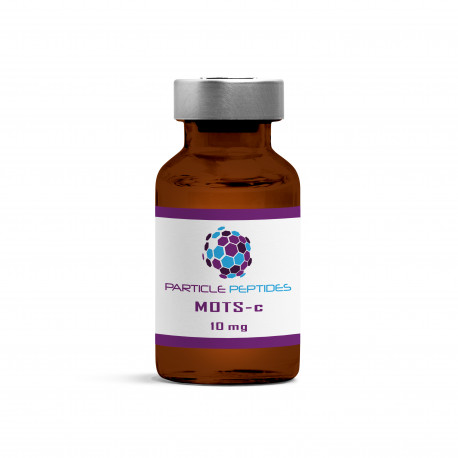
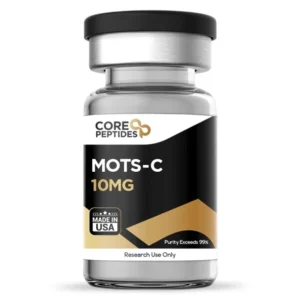
MOTS-c 10mg
€42.99
MOTS-c 10mg — Mitochondrial Peptide for Metabolic Research
MOTS-c 10mg is a small peptide encoded within the mitochondrial genome — a discovery that has positioned it as a subject of significant scientific interest in metabolic biology, longevity research and cellular stress response investigation. Supplied as a lyophilised white powder in a single 10mg vial with a verified purity of ≥99%, this compound is formulated to the precise standards required for in-vitro scientific research.
⚠️ Research Use Only. This product is intended exclusively for in-vitro scientific research. It is not approved for human or animal consumption, clinical use, or therapeutic application.
Table of Contents
- Product Specifications
- Mechanism of Action
- Metabolic Research Significance
- Research Applications
- Reconstitution and Storage
- FAQ
Product Specifications
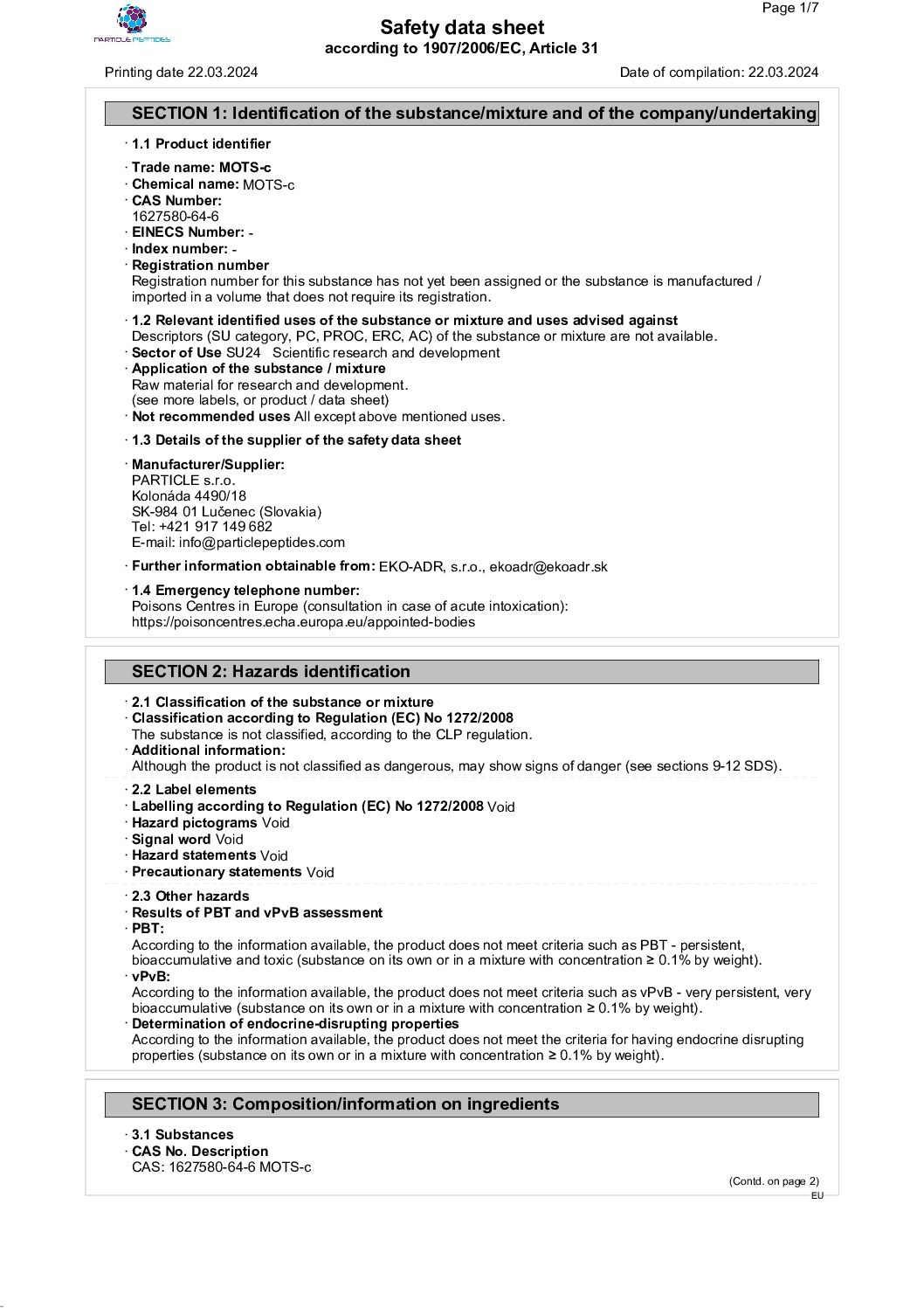
| Parameter | Detail |
|---|---|
| Peptide | MOTS-c |
| Quantity | 10mg |
| Unit | 1 Vial |
| Physical Appearance | White powder |
| Salt Form | Acetate |
| Peptide Purity | ≥99% |
| Molecular Mass | 2,174.6 Da |
| CAS Number | 1627580-64-6 |
| Solubility | Bacteriostatic water — 1ml/vial |
| Sequence | Met-Arg-Trp-Gln-Glu-Met-Gly-Tyr-Ile-Phe-Tyr-Pro-Arg-Lys-Leu-Arg |
Mechanism of Action
MOTS-c 10mg is unique among research peptides in that it originates not from the nuclear genome but from the mitochondrial genome — a small, circular DNA strand within the mitochondria that encodes a limited set of functional peptides. This mitochondrial origin distinguishes MOTS-c mechanistically from other metabolic peptides and confers it with properties directly linked to cellular energy status.
Under conditions of metabolic stress, MOTS-c translocates from its site of production in the mitochondria to the cell nucleus. Once in the nucleus, it regulates the expression of nuclear genes involved in maintaining cellular metabolic balance — a process researchers have termed retrograde signalling from mitochondria to the nucleus.
MOTS-c is co-expressed across multiple tissue types wherever mitochondria are present and has been detected in circulating plasma. Notably, plasma levels of this peptide decline with age — a finding that has positioned it as a subject of active investigation in the longevity and anti-aging research community.
Metabolic Research Significance
The most extensively studied property of mots c 10mg in published research is its role in glucose metabolism within skeletal muscle. Research has identified that MOTS-c improves glucose uptake and utilisation in skeletal muscle tissue — a mechanism of direct relevance to investigation of insulin resistance, type 2 diabetes and obesity-related metabolic dysfunction.
This glucose metabolism modulation is thought to occur through MOTS-c’s regulation of the AMPK pathway — a central cellular energy sensor involved in glucose and fat metabolism. Activation of this pathway has broad downstream effects on cellular energy balance and substrate utilisation.
Beyond glucose metabolism, researchers at the University of Southern California, where MOTS-c was first characterised around 2012, and subsequent investigative groups have explored its potential relevance to cardiovascular disease, chronic inflammation and the biology of age-related metabolic decline. The peptide’s age-dependent decline in plasma levels makes it particularly compelling as a research subject in the context of longevity biology.
Research Applications
Mots-c 10mg is actively investigated across the following research domains:
- Glucose metabolism and insulin sensitivity studies in skeletal muscle
- AMPK pathway activation and cellular energy regulation research
- Insulin resistance and type 2 diabetes investigation
- Obesity and metabolic syndrome research
- Cardiovascular disease marker and metabolic function studies
- Chronic inflammation investigation
- Aging biology and longevity research
- Mitochondrial-nuclear retrograde signalling studies
- Synthetic biology applications for peptide-based therapeutic development
Reconstitution and Storage
Reconstitute with bacteriostatic water at 1ml per vial. Add solvent slowly along the vial wall and allow to dissolve by gentle rotation. Do not shake or vortex.
Store lyophilised powder at −20°C. Once reconstituted, maintain at 4°C and use within the recommended timeframe consistent with your research protocol. Protect from direct light exposure and avoid repeated freeze-thaw cycles.
Explore additional research peptides in our Longevity and Anti-Age, Weight Loss and Healing research categories.
FAQ
What is MOTS-c 10mg? MOTS-c 10mg is a small peptide encoded within the mitochondrial genome, characterised by researchers at the University of Southern California around 2012. It regulates cellular metabolic balance by translocating from the mitochondria to the nucleus under metabolic stress, where it modulates nuclear gene expression. Research has demonstrated its role in glucose metabolism in skeletal muscle, with ongoing investigation into its potential relevance to diabetes, obesity, cardiovascular disease and aging biology. Supplied as a lyophilised white powder with ≥99% purity for in-vitro research.
What does MOTS-c 10mg dosage research involve? MOTS-c 10mg dosage parameters in published research vary by study model, tissue type and target endpoint. Preclinical investigations in animal models have used a range of concentrations to characterise dose-response relationships in glucose metabolism and AMPK pathway activation. This product is supplied for in-vitro research use only — no therapeutic or personal dosage recommendation is made or implied.
Is there a MOTS-c 10mg dosage calculator for research? A MOTS-c 10mg dosage calculator approach in research typically involves determining molar concentration from the molecular weight of 2,174.6 Da and the reconstitution volume to establish working concentrations for specific assay conditions. Researchers should calculate target concentrations based on published literature and their institutional research protocols. This compound is for in-vitro research only.
What is mots c 10mg dosage in published studies? Mots c 10mg dosage as examined in published preclinical studies varies by experimental model. Human plasma concentrations and in-vitro effective concentrations differ significantly. All dosage parameters for research use should be derived from peer-reviewed literature and approved institutional protocols. This compound is not approved for human administration.
Why do MOTS-c plasma levels decline with age? The age-related decline in MOTS-c plasma levels is an active area of investigation in longevity research. Current hypotheses suggest that mitochondrial function and mitochondrial genome expression decline with age — reducing the output of mitochondria-derived peptides including MOTS-c. This decline correlates in research models with reduced metabolic efficiency and increased insulin resistance, making MOTS-c a compelling subject for aging biology and longevity research.
What research areas is MOTS-c 10mg used for? MOTS-c 10mg is used in approved in-vitro research examining glucose metabolism in skeletal muscle, AMPK pathway regulation, insulin resistance, obesity-related metabolic dysfunction, cardiovascular disease markers, chronic inflammation and aging biology. Researchers have also explored synthetic biology approaches to MOTS-c application and therapeutic development. All applications are within approved in-vitro and preclinical frameworks.
Be the first to review “MOTS-c 10mg”
Related products

Muscle Growth research

Weight Loss Research
Immunity Enhancement Research
Core Peptides
Core Peptides
Core Peptides
Longevity and Anti-aging Research
Weight Loss Research
Reviews
There are no reviews yet.