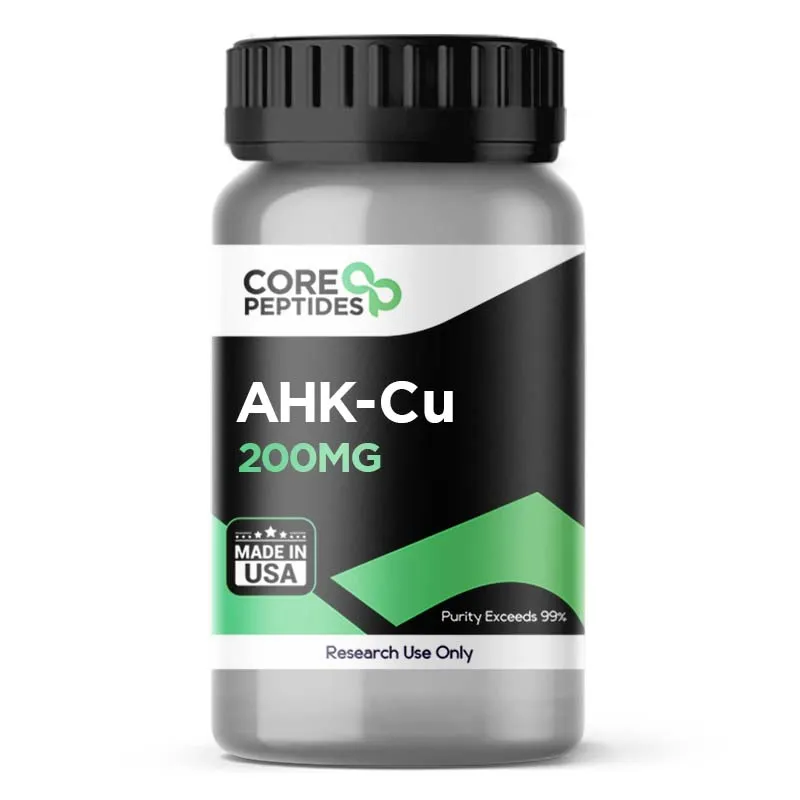
AHK-Cu 200mg
€182.70
AHK-Cu Peptide 200mg — Proven Copper Complex Research Compound
AHK-Cu peptide is a naturally occurring tripeptide composed of the amino acids alanine, histidine and lysine, with a copper ion coordinated across the binding domains of these three amino acid residues. This copper-peptide complex has been identified in circulating blood and is being actively investigated for its roles in vascular endothelial cell regulation, fibroblast activity, extracellular matrix biology and hair growth mechanisms. Supplied as a lyophilised powder in a single 200mg vial with a verified purity of >99%, this compound is formulated to the precise standards required for in-vitro scientific research.
⚠️ Research Use Only. This product is intended exclusively for in-vitro scientific research. It is not approved for human or animal consumption, clinical use, or therapeutic application.
Table of Contents
- Product Specifications
- Molecular Structure and Copper Coordination
- Fibroblast and ECM Research Context
- Hair Growth and Skin Research Applications
- Vascular Endothelial Biology
- Reconstitution and Storage
- FAQ
Product Specifications
| Parameter | Detail |
|---|---|
| Peptide | AHK-Cu (Copper AHK) |
| Composition | Alanine-Histidine-Lysine + Copper Ion |
| Quantity | 200mg |
| Unit | 1 Vial |
| Form | Lyophilised powder |
| Purity | >99% |
| SKU | P-AHK-CU |
Molecular Structure and Copper Coordination
AHK-Cu — also designated copper AHK — derives its biological activity from the coordination of a copper ion by multiple binding domains across the alanine, histidine and lysine residues of the tripeptide backbone.
Copper-peptide complexes represent a distinct class of research compounds. The copper ion in AHK-Cu is not simply attached to the peptide — it is geometrically coordinated in a manner that involves multiple amino acid side chains, producing a stable complex with unique biological recognition properties relative to either the free peptide or free copper ions alone.
This coordination chemistry is directly relevant to the peptide’s suggested presence in circulating blood — the complex form is proposed to represent a biologically active, transport-capable configuration that differs from non-chelated copper species in its cellular interactions.
Fibroblast and ECM Research Context
A central area of ahk cu peptide research involves its suggested activity on fibroblasts — the primary cell type responsible for synthesising and maintaining the extracellular matrix (ECM) surrounding cells in connective and skin tissue.
Fibroblasts produce the structural proteins of the ECM — including collagen, elastin and fibronectin — that provide mechanical support, tensile strength and biological scaffolding to tissue. Research has suggested that AHK-Cu may exert its primary activity on fibroblast function, potentially modulating ECM component production and tissue integrity maintenance.
Fibroblasts also secrete Vascular Endothelial Growth Factor (VEGF) — a signalling protein that promotes the formation of new blood vessels (angiogenesis). Research has examined whether AHK-Cu’s suggested effects on fibroblast activity extend to VEGF secretion and downstream vascular development, with implications for tissue repair and regeneration biology.
Hair Growth and Skin Research Applications
AHK-Cu has been specifically investigated for its potential in hair growth research and skin tissue integrity studies — two of the most active application areas for copper-peptide complexes in current research.
In hair growth biology, research has examined the peptide’s potential effects on follicular cell activity, dermal papilla function and the ECM environment surrounding hair follicles. The copper coordination is hypothesised to be relevant to the enzymatic processes involved in follicular cell proliferation and differentiation.
In skin tissue research, AHK-Cu’s suggested fibroblast-modulating activity is of direct relevance to dermal ECM maintenance — the degradation of which is a primary mechanism in skin aging. Investigations have explored whether copper AHK’s activity on fibroblasts can support the maintenance or restoration of ECM structural integrity in aged or compromised tissue models.
Vascular Endothelial Biology
AHK-Cu has been identified as naturally present in the bloodstream and has been suggested as a potential regulatory element in the growth, development and apoptosis of vascular endothelial cells — the cells lining the interior of blood vessels.
This vascular endothelial research application is mechanistically connected to the fibroblast-VEGF pathway described above. By potentially influencing fibroblast VEGF secretion, AHK-Cu may indirectly affect endothelial cell behaviour and angiogenic signalling — a mechanism of research interest in tissue repair, wound healing and vascular biology.
Explore additional anti-aging and longevity research peptides in our Anti-Age, Longevity and Anti-Age and Healing research categories.
FAQ
What is AHK-Cu peptide? AHK-Cu peptide is a copper-coordinated tripeptide composed of alanine, histidine and lysine, with a copper ion stably coordinated across the amino acid residues. It is naturally present in circulating blood and has been investigated for its potential regulatory roles in vascular endothelial cell biology, fibroblast activity, extracellular matrix maintenance, hair growth mechanisms and skin tissue integrity. Supplied as a 200mg lyophilised powder with >99% purity for in-vitro scientific research.
What is ahk-cu and how does it differ from GHK-Cu? AHK-Cu and GHK-Cu (glycine-histidine-lysine copper) are both copper-coordinated tripeptides naturally present in plasma, but they differ in their amino acid composition and resulting biological activity profiles. AHK-Cu substitutes alanine for glycine at the N-terminus — a structural difference that produces distinct receptor interactions and potentially different fibroblast and ECM activity profiles. Research comparing ahk cu vs ghk cu has examined these differences in the context of hair growth, skin tissue and vascular endothelial biology.
What does ahk cu peptide research focus on? Ahk cu peptide research focuses primarily on fibroblast activity and ECM biology, hair follicle biology and growth mechanisms, skin tissue integrity and dermal aging research, vascular endothelial cell regulation, VEGF secretion and angiogenesis, and the broader biology of copper-peptide complexes in circulating blood. All research is conducted within approved in-vitro frameworks.
What do researchers say about AHK-Cu in published studies? Published research on AHK-Cu has examined its presence in plasma, its suggested activity on vascular endothelial cell growth and apoptosis, and its potential effects on fibroblast function and ECM component production. Ahk cu reddit discussions among researchers and enthusiasts frequently reference comparisons with GHK-Cu — noting AHK-Cu as a structurally distinct compound with its own research profile rather than a direct substitute.
Is AHK-Cu the same as copper AHK? Yes — AHK-Cu and copper AHK are two designations for the same compound. Both refer to the alanine-histidine-lysine tripeptide coordinated with a copper ion. The “Cu” in AHK-Cu is the elemental symbol for copper, making both names direct descriptions of the compound’s molecular composition.
What is the difference between AHK-Cu and free copper in research? The copper coordination in AHK-Cu produces a biologically distinct complex from free ionic copper. The geometric coordination across multiple amino acid residues creates a stable chelate with different cellular recognition, membrane interaction and signalling properties compared to free Cu2+ ions. This is why copper-peptide complexes like AHK-Cu are studied as functionally distinct research entities rather than simply as copper delivery vehicles.
Be the first to review “AHK-Cu 200mg”
Related products
Core Peptides
Core Peptides
Core Peptides
Longevity and Anti-aging Research
Core Peptides
Healing and Regeneration research
Core Peptides
Core Peptides
Reviews
There are no reviews yet.