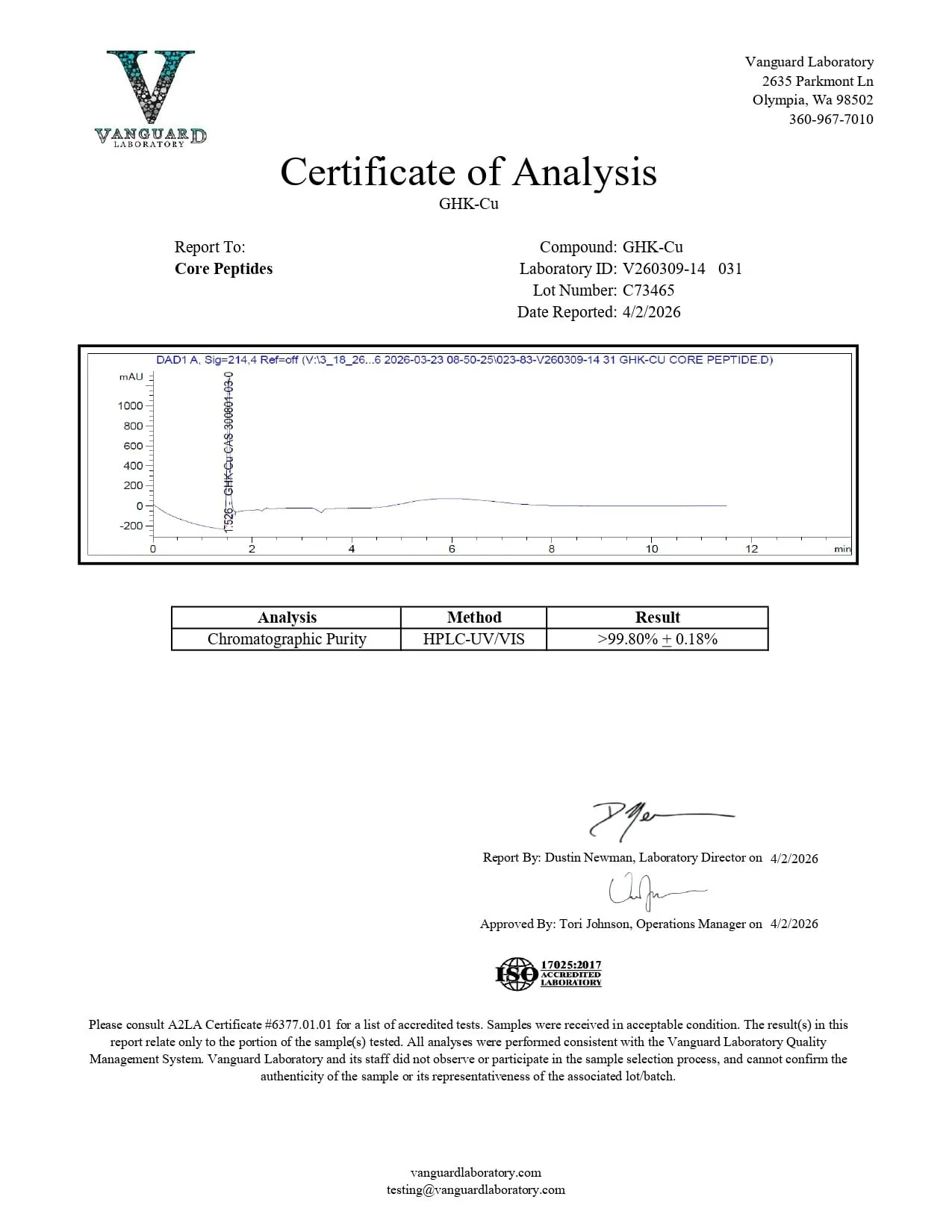
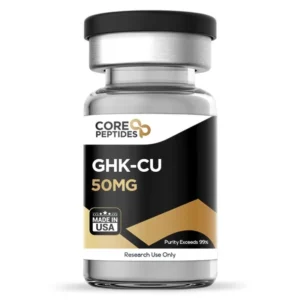
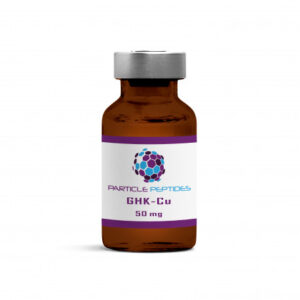
GHK-Cu (Copper) 50mg
€52.20
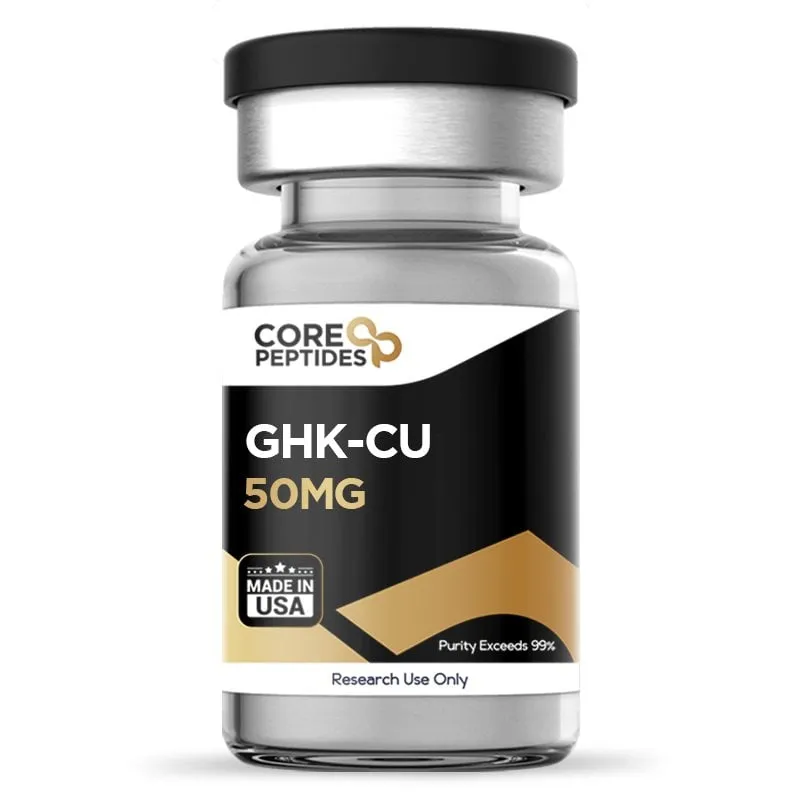
GHK-Cu 50mg — Proven Copper Peptide Collagen Research Compound
GHK-Cu 50mg is the copper-coordinated complex of the naturally occurring tripeptide glycyl-L-histidyl-L-lysine — a small peptide found in human plasma that is released at the time of injury and whose concentration declines significantly with age. At 20 years, plasma GHK-Cu concentration averages approximately 200 ng/mL — declining to around 80 ng/mL by age 60. This age-dependent decline in a peptide associated with tissue repair, collagen synthesis and cell-protective biology has made GHK-Cu one of the most actively investigated compounds in aging and regenerative research. Supplied as a lyophilised blue powder in a 50mg vial at >99% purity for in-vitro scientific research.
⚠️ Research Use Only. This product is intended exclusively for in-vitro scientific research. It is not approved for human or animal consumption, clinical use, or therapeutic application.
Table of Contents
- Product Specifications
- Plasma Origin and Age-Related Decline
- Copper Chelation Biology
- Collagen, Elastin and ECM Synthesis Research
- Angiogenesis and Nerve Outgrowth Research
- Cell Culture Research Profile
- Research Applications
- Reconstitution and Storage
- FAQ
Product Specifications
| Parameter | Detail |
|---|---|
| Peptide | GHK-Cu (Copper) |
| Sequence | Gly-His-Lys (Cu²⁺) |
| Classification | Naturally Occurring Copper-Binding Peptide |
| Physical Appearance | Blue powder (copper coordination) |
| Quantity | 50mg |
| Unit | 1 Vial |
| Form | Lyophilised powder |
| Purity | >99% |
| SKU | P-GHKCU-50 |
Note: The blue colouration of this compound is normal and expected — it arises directly from the Cu²⁺ coordination within the peptide complex and confirms copper chelation integrity.
Plasma Origin and Age-Related Decline
GHK-Cu is a small tripeptide naturally present in human plasma — and the story of its age-related concentration change is one of the most compelling arguments for its sustained research interest in longevity biology.
At age 20, average plasma GHK-Cu concentration is approximately 200 ng/mL. By age 60, this has declined to approximately 80 ng/mL — a reduction of 60% across four decades. This dramatic, progressive decline occurs over precisely the same time period when the most visible age-associated changes in tissue repair capacity, skin quality and regenerative biology are typically observed.
The correlation between declining plasma GHK-Cu and the progressive degradation of tissue repair capacity with age has driven substantial research interest in whether this decline is causally involved in aging-associated tissue changes — or merely correlational. Investigating this question is one of the primary motivations for GHK-Cu in-vitro research.
Copper Chelation Biology
The “-Cu” component of ghk cu 50mg designates the copper ion coordination that distinguishes this preparation from GHK Basic — the unchelated free tripeptide. The copper in GHK-Cu is a divalent Cu²⁺ ion coordinated by the imidazole nitrogen of the histidine residue alongside other coordinating atoms within the tripeptide structure.
This multi-dentate copper coordination produces a stable complex with distinct biological recognition properties relative to either the free peptide or free ionic copper. The coordinated copper contributes its own cellular interaction profile — including potential involvement in superoxide dismutase-like antioxidant activity, collagen cross-linking enzyme activity (lysyl oxidase) and copper-dependent gene regulation mechanisms.
Research conducted on the chelation properties of GHK-Cu has noted that during isolation, the peptide exhibited potential co-isolation with approximately equimolar amounts of copper ions and a proportion of iron — suggesting the peptide may have broader metal-binding properties beyond simple copper coordination. When incubated in isolated cells as a bound complex with copper and iron molecules, maximal biological potential was reported — indicating the full metal-coordinated complex may be the most biologically active form.
Collagen, Elastin and ECM Synthesis Research
The buy ghk-cu peptide research profile in ECM biology is one of the most extensively documented in the copper peptide literature. Research has characterised GHK-Cu’s capacity to stimulate collagen synthesis in dermal fibroblast models — specifically Type I and Type III collagen, the primary structural proteins of the dermis. This collagen stimulation is of direct research relevance to wound healing, skin aging biology and connective tissue repair.
Elastin synthesis stimulation has been documented alongside collagen — addressing the elasticity dimension of extracellular matrix quality that declines with age as elastin fibres degrade and are not adequately replaced. Glycosaminoglycan production enhancement — including hyaluronic acid — adds a third dimension of ECM research relevance, affecting tissue hydration and matrix architecture.
Angiogenesis and Nerve Outgrowth Research
Beyond ECM synthesis, ghk-cu peptide injection where to buy research interest often reflects the compound’s investigated capacity to stimulate angiogenesis — new blood vessel formation — and nerve outgrowth.
Both processes are essential to the vascular and neural dimensions of tissue repair that must accompany structural ECM restoration for complete functional tissue recovery. Blood vessel outgrowth ensures adequate oxygen and nutrient supply to healing tissue. Nerve outgrowth restores sensory and motor innervation essential for full functional recovery.
These angiogenic and neurogenic research properties extend GHK-Cu’s research relevance beyond dermal biology to any tissue context where revascularisation and re-innervation are repair rate-limiting factors.
Cell Culture Research Profile
In vitro studies have examined the effects of adding plasma GHK peptide to cell cultures in nanomolar concentrations — an experimental approach that has yielded some of the most informative findings in GHK research.
At nanomolar concentrations in cell culture, GHK-Cu has demonstrated the potential to induce a wide range of cellular responses — from growth stimulation at lower concentrations to effects on cell differentiation at higher concentrations. This concentration-dependent response profile is a characteristic feature of signalling peptides and is consistent with GHK-Cu’s proposed role as a cell communication molecule that modulates cellular behaviour across a range of biological endpoints depending on the specific cellular context and concentration.
Research Applications
GHK-Cu (Copper) is investigated within the following approved in-vitro research domains:
- Collagen, elastin and glycosaminoglycan synthesis studies
- Dermal fibroblast activation and tissue repair research
- Angiogenesis and blood vessel outgrowth investigation
- Nerve outgrowth and neural repair biology
- Copper chelation and metal-binding peptide pharmacology
- Cell culture concentration-response biology
- Age-related plasma GHK decline and longevity research
- Anti-inflammatory pathway and NFκB suppression studies
- DNA repair gene expression research
- Skin barrier and protective protein biology
Reconstitution and Storage
Reconstitute with sterile or bacteriostatic water. The reconstituted solution will be blue — this is expected and confirms GHK-Cu copper coordination integrity. Add solvent slowly along the vial wall and allow to dissolve by gentle rotation. Do not use copper-chelating agents in reconstitution buffers as these may displace the coordinated Cu²⁺.
Store lyophilised powder at −20°C. Once reconstituted, maintain at 4°C and use within the timeframe specified by your research protocol. Protect from light and avoid repeated freeze-thaw cycles.
Explore additional copper peptide and anti-aging research compounds in our Anti-Age, Healing and Longevity research categories.
FAQ
What is GHK-Cu 50mg? GHK-Cu 50mg is the copper-coordinated complex of glycyl-L-histidyl-L-lysine — a naturally occurring tripeptide found in human plasma that declines from ~200 ng/mL at age 20 to ~80 ng/mL by age 60. It is researched for collagen, elastin and glycosaminoglycan synthesis stimulation, fibroblast activation, blood vessel and nerve outgrowth, anti-inflammatory NFκB suppression, DNA repair gene upregulation and cell-protective biology. Supplied as a 50mg blue lyophilised powder with >99% purity for in-vitro scientific research.
How can I buy GHK-Cu peptide? Buy GHK-Cu peptide through specialist research peptide suppliers. This compound is supplied strictly for in-vitro scientific research. It is not approved for human consumption, therapeutic use or clinical application. Researchers should ensure compliance with all applicable institutional requirements. For the unchelated GHK peptide without copper, the GHK Basic preparation is available separately.
What is GHK-Cu peptide injection and can it be used in research? GHK-Cu peptide injection where to buy refers to sourcing GHK-Cu for in-vivo preclinical research models where administration routes including subcutaneous and intradermal injection have been examined. This product is supplied for in-vitro scientific research use only. Administration of this compound in human subjects is not within its intended research use and it is not approved for human injection or therapeutic application.
What is the difference between ghk cu 50mg and GHK Basic? GHK cu 50mg is the copper-coordinated complex — characterised by its blue colouration arising from Cu²⁺ chelation. GHK Basic is the unchelated free tripeptide — colourless in solution. GHK-Cu’s copper coordination introduces additional biological activities through the copper ion’s own cellular interactions including antioxidant-adjacent activity, copper-dependent enzyme activation and metal-binding biology. Research comparing both preparations enables mechanistic separation of peptide-intrinsic versus copper-mediated biological effects.
Why does GHK-Cu decline with age and why does this matter? GHK-Cu plasma concentration declines from approximately 200 ng/mL at age 20 to approximately 80 ng/mL by age 60 — a 60% reduction over the period during which age-related tissue repair capacity, skin quality and regenerative biology most visibly decline. Research investigating whether this correlation reflects a causal relationship examines GHK-Cu’s proposed role as a tissue repair signalling molecule whose age-related decline may contribute to the progressive reduction in healing capacity and tissue maintenance quality observed in aging biology.
Be the first to review “GHK-Cu (Copper) 50mg”
Related products
Core Peptides
Longevity and Anti-aging Research
Immunity Enhancement Research
Longevity and Anti-aging Research
Cognitive Enhancement Research
Longevity and Anti-aging Research
Core Peptides
Longevity and Anti-aging Research
Reviews
There are no reviews yet.