
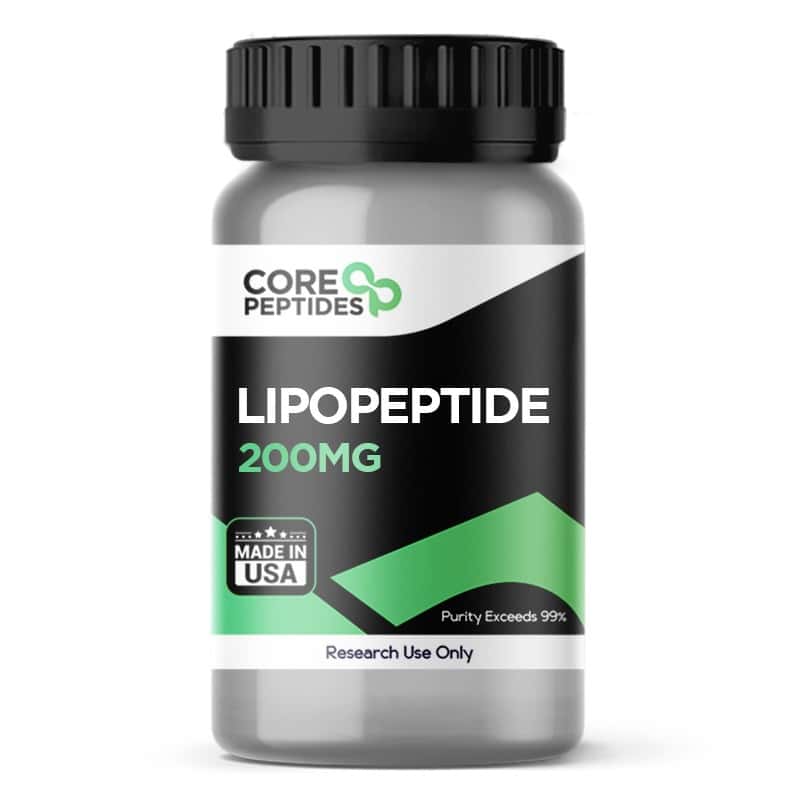
Lipopeptide (Palmitoyl-Gly-Gln-Pro-Arg) 200mg
$174.60
Lipopeptide 200mg — Proven IgG-Derived Skin Penetration Research Compound
Lipopeptide — characterised by the sequence Palmitoyl-Gly-Gln-Pro-Arg — is a palmitoylated tetrapeptide fragment derived from immunoglobulin G (IgG), the primary antibody class involved in mediating various inflammatory processes. The defining structural feature of this compound is its palmitoylation — the covalent attachment of a palmitic acid (C16:0) fatty acid molecule to the N-terminus of the Gly-Gln-Pro-Arg peptide sequence. This lipid modification is the mechanistic basis for the compound’s investigated capacity to penetrate through corneal layers of skin tissue models — a property of significant research interest in dermal biology and skin-targeted compound delivery investigation. Supplied as a lyophilised powder in a 200mg vial at >99% purity for in-vitro scientific research.
⚠️ Research Use Only. This product is intended exclusively for in-vitro scientific research. It is not approved for human or animal consumption, clinical use, or therapeutic application.
Table of Contents
- Product Specifications
- IgG Derivation and Immunological Context
- Palmitoylation Chemistry and Significance
- Skin Penetration Research
- Inflammatory Pathway Research
- Research Applications
- Reconstitution and Storage
- FAQ
Product Specifications
| Parameter | Detail |
|---|---|
| Compound | Lipopeptide |
| Sequence | Palmitoyl-Gly-Gln-Pro-Arg |
| Parent Molecule | Immunoglobulin G (IgG) |
| Modification | N-terminal palmitoylation (C16:0 fatty acid) |
| Quantity | 200mg |
| Unit | 1 Vial |
| Form | Lyophilised powder |
| Purity | >99% |
| SKU | P-LIPOPEPTIDE-200 |
IgG Derivation and Immunological Context
Lipopeptide is derived from immunoglobulin G — the most abundant antibody class in human serum, constituting approximately 75% of total serum antibodies. IgG mediates a broad range of immune functions including pathogen neutralisation, complement activation, opsonisation and the regulation of various inflammatory processes.
The Gly-Gln-Pro-Arg tetrapeptide sequence represents a specific fragment of the IgG structure — isolated and characterised for its potential biological activity independent of the full immunoglobulin context. The derivation from IgG — a central immune regulatory molecule — connects the lipo peptide research profile to inflammatory pathway biology and immune signalling research domains.
Understanding the biological context of the parent IgG molecule is relevant to interpreting the anti-inflammatory research dimensions of the Lipopeptide, as the fragment may retain some of the inflammatory regulatory properties of the parent antibody in a structurally simplified, more cell-accessible form.
Palmitoylation Chemistry and Significance
The palmitoylation modification is the most mechanistically significant structural feature of lipo c peptide for sale research preparations. Palmitoylation — the attachment of palmitic acid (a 16-carbon saturated fatty acid) to the N-terminus of the peptide — transforms the hydrophilic tetrapeptide into an amphiphilic lipopeptide with fundamentally different membrane interaction properties.
The fatty acid component of palmitoyl modification is chemically compatible with the lipid-rich environment of cell membranes and the outer corneal layers of skin tissue. This lipid-environment compatibility is the proposed basis for the enhanced penetration observed in skin tissue model research — the palmitic acid component facilitating traversal of the lipid-rich outer epidermis that otherwise presents a significant barrier to hydrophilic peptide delivery.
Beyond penetration enhancement, palmitoylation may also improve stability to skin proteases — the enzymes present in skin tissue that rapidly degrade unmodified peptides. The fatty acid modification creates steric protection around the peptide backbone that reduces susceptibility to protease-mediated cleavage.
Skin Penetration Research
The primary applied research direction for lipopeptide investigation is skin tissue penetration — specifically the capacity to traverse the corneal layers of skin tissue models that typically limit peptide access to deeper dermal layers.
The stratum corneum — the outermost layer of the epidermis — is a densely packed barrier of keratin-rich corneocytes embedded in a lipid matrix. This lipid matrix is the primary barrier to most hydrophilic compounds, including unmodified peptides. The palmitoylation of Lipopeptide introduces the lipid compatibility required to partition into and traverse this lipid-rich environment.
Research examining Lipopeptide’s penetration through skin tissue models investigates the depth of penetration achievable, the concentration gradient established across tissue layers, and whether adequate concentrations reach deeper dermal targets — including dermal fibroblasts and the dermis-epidermis junction structures relevant to skin biology research.
Inflammatory Pathway Research
The IgG derivation of Lipopeptide connects it to inflammatory pathway research — an area where the parent immunoglobulin exerts diverse regulatory influences. Research has investigated whether the Gly-Gln-Pro-Arg fragment of IgG retains inflammatory modulation properties relevant to skin biology and broader immune research contexts.
Inflammatory pathway research with Lipopeptide examines its potential effects on cytokine expression, inflammatory mediator production and the immune regulatory processes mediated by IgG-derived fragments in relevant cell culture models.
Research Applications
Lipopeptide is investigated within the following approved in-vitro research domains:
- Skin tissue penetration and corneal layer permeation studies
- Palmitoylation modification pharmacology research
- IgG-derived peptide fragment biology
- Inflammatory pathway modulation investigation
- Protease stability and peptide delivery research
- Dermal fibroblast access and target engagement studies
- Lipid-peptide conjugate skin biology research
- Epidermal barrier interaction investigation
Reconstitution and Storage
Reconstitute following standard lyophilised peptide protocols appropriate to your research application. Note: the palmitoyl modification may affect aqueous solubility — use appropriate solvent conditions for your specific assay requirements. Store lyophilised powder at −20°C. Once reconstituted, maintain at 4°C and protect from light. Avoid repeated freeze-thaw cycles.
Explore additional skin research and anti-aging compounds in the Longevity and Anti-aging Research and Healing and Regeneration Research categories.
FAQ
What is lipopeptide? Lipopeptide is a palmitoylated tetrapeptide (Palmitoyl-Gly-Gln-Pro-Arg) derived from immunoglobulin G. The palmitoylation — attachment of a C16:0 fatty acid to the N-terminus — enhances skin tissue penetration by facilitating traversal of the lipid-rich stratum corneum. Research investigates its capacity to penetrate corneal skin layers, its IgG-derived inflammatory pathway biology and its potential stability to skin proteases. Supplied as a 200mg lyophilised powder with >99% purity for in-vitro scientific research.
What is lipo peptide and how does it differ from other peptides? Lipo peptide refers to lipopeptide — a class of peptides modified with a lipid component (in this case palmitoyl) that fundamentally alters membrane interaction properties. Unlike standard hydrophilic peptides that cannot easily traverse the lipid-rich stratum corneum, this lipopeptide’s fatty acid component provides the lipid environment compatibility needed for skin penetration research applications.
What is lipo c peptide for sale in research contexts? Lipo c peptide for sale refers to lipopeptide research preparations — palmitoylated peptide compounds with enhanced lipid membrane penetration properties. This Lipopeptide (Palmitoyl-Gly-Gln-Pro-Arg) is an IgG-derived research compound supplied for in-vitro scientific research. It is not a clinical cosmetic product or supplement. All research use should comply with institutional requirements.
Why does palmitoylation enhance skin penetration? Palmitoylation enhances skin penetration by introducing a 16-carbon saturated fatty acid component that is chemically compatible with the lipid matrix of the stratum corneum — the primary barrier to peptide skin penetration. The fatty acid component partitions into and traverses this lipid-rich environment, carrying the attached peptide sequence into deeper skin tissue layers. Additionally, the palmitoyl modification may provide steric protection against skin surface protease degradation, extending the peptide’s research activity window.
What is the IgG biological significance of lipopeptide? IgG — immunoglobulin G — is the most abundant serum antibody and a central mediator of immune regulatory processes including pathogen neutralisation, complement activation and inflammatory pathway modulation. Lipopeptide’s derivation from IgG connects it to these immunological regulatory domains. Research examining whether the Gly-Gln-Pro-Arg fragment retains inflammatory modulation properties of the parent immunoglobulin investigates the fragment’s potential as an IgG-derived research tool for inflammatory pathway biology.
Be the first to review “Lipopeptide (Palmitoyl-Gly-Gln-Pro-Arg) 200mg”
Related products
Longevity and Anti-aging Research
Longevity and Anti-aging Research
Core Peptides
Healing and Regeneration research
Core Peptides
Longevity and Anti-aging Research
Cognitive Enhancement Research
Cognitive Enhancement Research
Reviews
There are no reviews yet.