
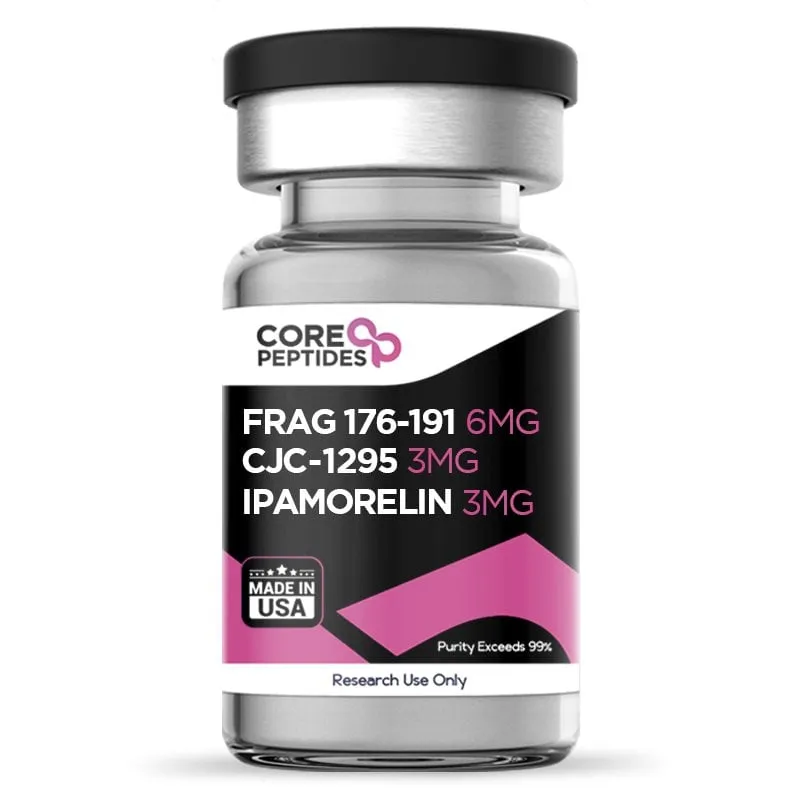
Fragment 176-191 & CJC-1295 No DAC & Ipamorelin Blend 12mg
€65.70
HGH Fragment 176-191 — Proven Triple Peptide Weight Research Blend 12mg
The HGH fragment 176-191 blend with CJC-1295 No DAC and Ipamorelin is a precision-formulated three-component research preparation combining the lipolytic GH fragment (6mg), a GHRH receptor agonist (3mg) and a GHS-R1a agonist (3mg) — three mechanistically distinct peptides proposed by researchers to act synergistically when combined. Fragment 176-191 targets adipose tissue fat metabolism through beta-3 adrenergic receptor engagement. CJC-1295 No DAC stimulates GH release through GHRH receptor activation. Ipamorelin stimulates GH release through GHS-R1a ghrelin receptor agonism. Together, this blend covers lipolytic, GH-stimulating and metabolic regulatory dimensions of growth hormone and fat metabolism research. Supplied at >99% purity for in-vitro scientific research.
⚠️ Research Use Only. This product is intended exclusively for in-vitro scientific research. It is not approved for human or animal consumption, clinical use, or therapeutic application.
Table of Contents
- Product Specifications
- Fragment 176-191 Component Profile
- CJC-1295 No DAC Component Profile
- Ipamorelin Component Profile
- Synergistic Triple Blend Research Rationale
- Research Applications
- Reconstitution and Storage
- FAQ
Product Specifications
| Parameter | Detail |
|---|---|
| Blend | Fragment 176-191 + CJC-1295 No DAC + Ipamorelin |
| Total Quantity | 12mg |
| Fragment 176-191 | 6mg |
| CJC-1295 No DAC (Mod GRF 1-29) | 3mg |
| Ipamorelin | 3mg |
| Form | Lyophilised powder |
| Purity | >99% |
| SKU | P-FRAGCJCIPAM-12 |
Fragment 176-191 Component Profile
The fragment 176-191 component — also designated frag peptide in research shorthand — is a 15-amino-acid fragment of human growth hormone, specifically comprising residues 176 through 191 of the full 191-amino-acid hGH molecule. This C-terminal region of hGH has been characterised as the lipolytic domain of the growth hormone — the specific segment associated with fat metabolism activity rather than the growth-promoting or insulin-related properties of other GH regions.
Research has suggested that Fragment 176-191 may target beta-3 adrenergic receptors (ADRB3) — G-protein-coupled receptors expressed primarily in adipose tissue and skeletal muscle, where their activation is linked to lipolysis stimulation and thermogenesis induction. Through this receptor engagement, the peptide is proposed to potentially boost fat burning in adipose tissue cells and promote thermogenesis in skeletal muscle cells — a mechanistically distinct approach to fat metabolism investigation compared to conventional metabolic research tools.
The 6mg quantity of Fragment 176-191 in this blend — the largest component by weight — reflects its primary research role as the fat metabolism focus of the preparation.
CJC-1295 No DAC Component Profile
CJC-1295 No DAC — designated Modified GRF (1-29) — is a synthetic 29-amino-acid GHRH analogue that activates GHRH receptors in the pituitary gland through the same receptor system engaged by native GHRH. As the GHRH receptor agonist component of this fragment 176-191 blend, it contributes GH-stimulating activity through the cAMP-mediated pituitary signalling pathway.
The No DAC specification confirms this preparation does not contain the albumin-binding Drug Affinity Complex — producing the acute, pulsatile GH release profile appropriate for this research blend rather than the sustained stimulation of DAC-modified CJC-1295.
Ipamorelin Component Profile
Ipamorelin is a synthetic pentapeptide GH secretagogue that activates GHS-R1a ghrelin receptors to stimulate GH release from anterior pituitary cells — the same receptor system engaged by endogenous ghrelin. As the ghrelin receptor agonist component of this blend, it contributes GH-stimulating activity through the IP3/calcium intracellular signalling pathway — mechanistically distinct from the cAMP pathway activated by CJC-1295.
Ipamorelin’s selectivity — not producing significant ACTH or cortisol elevation at GH-stimulating doses — makes it the appropriate GHS-R1a agonist for research protocols where adrenal axis confounding must be minimised.
Synergistic Triple Blend Research Rationale
The research rationale for this triple-component blend rests on three mechanistically distinct and non-redundant biological activities operating simultaneously.
Fragment 176-191 engages beta-3 adrenergic receptors in adipose and skeletal muscle tissue — targeting fat metabolism at the peripheral tissue level through a mechanism independent of the central GH axis. CJC-1295 No DAC engages GHRH receptors — stimulating GH release through the cAMP-PKA pathway at the pituitary level. Ipamorelin engages GHS-R1a receptors — stimulating GH release through the IP3/calcium pathway at the pituitary level.
Together, these three mechanisms cover peripheral fat metabolism, central GH axis GHRH receptor stimulation and central GH axis ghrelin receptor stimulation — three distinct biological dimensions that have been suggested by researchers to synergistically enhance GH concentration, regulate GH equilibrium levels and provide a more comprehensive metabolic and GH biology research profile than any individual component delivers independently.
The blend’s proposed effects — increased fat metabolism, increased lean mass support, regulated sleep cycle correlation and enhanced intestinal and cardiac functioning — reflect the downstream consequences of this multi-mechanism GH and metabolic biology engagement.
Research Applications
This blend is investigated within the following approved in-vitro research domains:
- Beta-3 adrenergic receptor activation and lipolysis research
- Fat metabolism and thermogenesis investigation
- Multi-receptor GH secretagogue synergy studies
- GHRH receptor and GHS-R1a simultaneous activation research
- GH concentration regulation and equilibrium investigation
- Metabolic rate and body composition research
- Lean mass support biology investigation
- Sleep regulation and GH pulse correlation studies
Reconstitution and Storage
Reconstitute with sterile or bacteriostatic water. Add solvent slowly along the vial wall and allow to dissolve by gentle rotation. Do not shake or vortex. Store lyophilised powder at −20°C. Once reconstituted, maintain at 4°C and use within the timeframe specified by your research protocol. Protect from light and avoid repeated freeze-thaw cycles.
Explore additional GH blend and weight loss research compounds in our Weight Loss, Anti-Age and Muscle Growth research categories.
FAQ
What is the HGH fragment 176-191 blend? The HGH fragment 176-191 blend combines Fragment 176-191 (6mg), CJC-1295 No DAC (3mg) and Ipamorelin (3mg) in a single 12mg lyophilised research vial at >99% purity. Fragment 176-191 targets beta-3 adrenergic receptors for lipolysis research. CJC-1295 activates GHRH receptors for GH release. Ipamorelin activates GHS-R1a for GH release through a separate pathway. Together they are proposed to synergistically enhance GH and fat metabolism research. For in-vitro scientific research only.
What is a frag peptide in research contexts? Frag peptide is the common research shorthand for Fragment 176-191 — the 15-amino-acid C-terminal fragment of human growth hormone. It is characterised as the lipolytic domain of hGH, investigated for its potential to target beta-3 adrenergic receptors in adipose tissue and skeletal muscle to stimulate fat burning and thermogenesis. As the largest component of this blend at 6mg, it is the primary lipolytic research element.
What is fragment 176-191 and how does it differ from full hGH? Fragment 176-191 reproduces only residues 176–191 of the 191-amino-acid hGH molecule — the C-terminal region specifically associated with lipolytic activity. Full-length hGH contains additional domains with insulin-potentiating and mitogenic properties. Research has characterised Fragment 176-191 as the isolated lipolytic domain without the growth-promoting or insulin-related effects of full hGH — making it a mechanistically specific research tool for fat metabolism investigation.
Why combine Fragment 176-191 with CJC-1295 and Ipamorelin? The combination addresses three distinct biological dimensions simultaneously. Fragment 176-191 provides peripheral beta-3 adrenergic receptor-mediated lipolysis research coverage. CJC-1295 provides central GHRH receptor-mediated GH stimulation through cAMP-PKA signalling. Ipamorelin provides central GHS-R1a-mediated GH stimulation through IP3/calcium signalling. These three non-redundant mechanisms are proposed to produce synergistic GH and fat metabolism research effects beyond what any single component achieves.
What downstream effects does the hgh fragment 176-191 blend address in research? Downstream research effects investigated with this hgh fragment 176-191 blend include increased fat metabolism through beta-3 adrenergic receptor activation, lean mass support through GH-mediated anabolic signalling, regulated sleep cycle investigation through GH pulse correlation, and enhanced intestinal and cardiac functioning via GH axis stimulation. All effects are within approved in-vitro and preclinical research frameworks.
Be the first to review “Fragment 176-191 & CJC-1295 No DAC & Ipamorelin Blend 12mg”
Related products
Immunity Enhancement Research
Core Peptides
Longevity and Anti-aging Research
Weight Loss Research
Longevity and Anti-aging Research
Sleep Enhancement Research
Cognitive Enhancement Research
Core Peptides
Reviews
There are no reviews yet.