

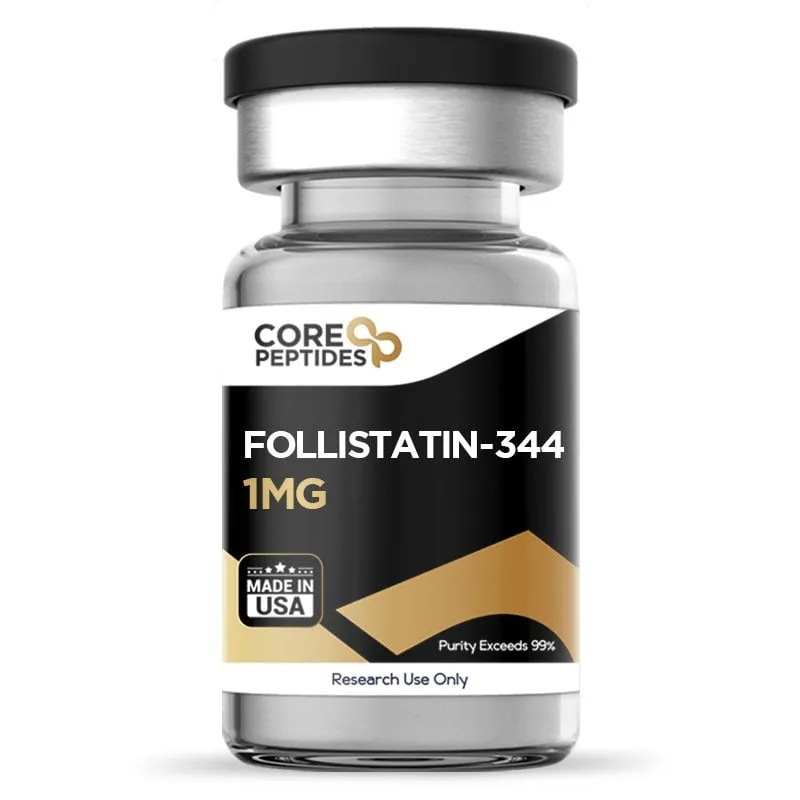
Follistatin-344 1mg
€124.20
Follistatin 344 Peptide 1mg — Proven Myostatin Regulator Research Compound
Follistatin 344 peptide — the synthetic version of the endogenous Follistatin-344 glycoprotein isoform — is a naturally occurring protein found in virtually all tissues that functions as an autocrine signalling molecule and is considered the predominantly expressed follistatin isoform across most tissue types. With a structure comprising 63 core amino acid residues organised across three follistatin domain units (FSD1, FSD2, FSD3), this compound has been extensively investigated for its capacity to bind and regulate activins, myostatin and related TGF-β superfamily ligands — biological regulators of muscle growth, reproductive function and tissue homeostasis. Supplied as a lyophilised powder in a single 1mg vial with a verified purity of >99% for in-vitro scientific research.
⚠️ Research Use Only. This product is intended exclusively for in-vitro scientific research. It is not approved for human or animal consumption, clinical use, or therapeutic application.
Table of Contents
- Product Specifications
- Follistatin Isoform Biology
- Autocrine Signalling Mechanism
- Myostatin and TGF-β Superfamily Research
- Follistatin-344 vs Follistatin-315/317
- Domain Architecture Research
- Research Applications
- Reconstitution and Storage
- FAQ
Product Specifications
| Parameter | Detail |
|---|---|
| Protein | Follistatin-344 (FST 344) |
| Classification | Naturally Occurring Glycoprotein / Autocrine Signalling Molecule |
| Core Residues | 63 amino acids |
| Domains | FSD1, FSD2, FSD3 |
| Total Amino Acids | 315 (FST-344 isoform) |
| Parent Molecule Amino Acids | 344 |
| Quantity | 1mg |
| Unit | 1 Vial |
| Form | Lyophilised powder |
| Purity | >99% |
| SKU | P-FOLLISTN-1 |
Follistatin Isoform Biology
Follistatin 344 peptide exists within a broader follistatin isoform biology that requires careful clarification — particularly regarding the naming conventions used across the research literature.
Follistatin naturally occurs in two primary isoforms produced through alternative splicing of the mRNA — designated FST-317 and FST-344. The naming convention for these isoforms is based on the parent molecules from which they are derived — containing 317 and 344 amino acids respectively in the parent molecular form.
The FST-344 isoform — this product — contains 315 amino acids in the mature processed form (despite being derived from the 344 amino acid parent molecule). FST-317 contains 288 amino acids. The mature FST-344 isoform with 315 residues accounts for the predominant expression across most tissues — while FST-317 may account for less than 5% of the encoded mRNA in most tissue contexts.
This tissue-predominant expression pattern is a critical research consideration — Follistatin-344 is the physiologically relevant isoform in most biological contexts, making it the appropriate research tool for investigation of follistatin biology in general tissue settings.
Autocrine Signalling Mechanism
Follistatin 344 peptide is classified as an autocrine chemical — a signalling molecule produced by a cell that binds to receptors on the same cell that produced it, triggering autocrine receptor-mediated cell modification. This autocrine signalling classification distinguishes follistatin’s mechanism from paracrine signals (acting on neighbouring cells) and endocrine signals (acting systemically through circulation).
The autocrine nature of follistatin signalling means that its research effects are most directly relevant to the cells that produce it — creating a self-regulatory loop where follistatin production is connected to the cellular context of its own bioactivity. Understanding this autocrine framework is essential for designing in-vitro research protocols that accurately capture the compound’s biological activity.
Myostatin and TGF-β Superfamily Research
The primary research significance of buy follistatin-344 compounds lies in follistatin’s well-characterised capacity to bind and neutralise myostatin — the TGF-β superfamily member that negatively regulates skeletal muscle growth. Myostatin binds to ActRIIB receptors on muscle cells to initiate the Smad2/3 signalling cascade that inhibits muscle hypertrophy. Follistatin-344 binds myostatin directly in the extracellular space — sequestering it before receptor engagement and thereby allowing muscle hypertrophy pathways to proceed without myostatin-mediated inhibition.
This mechanism is the primary driver of research interest in Follistatin-344 for muscle biology. By binding myostatin — and other TGF-β superfamily members including multiple activins and growth differentiation factors — Follistatin-344 functions as a broad endogenous regulator of the TGF-β signalling environment in muscle and other tissues.
The activin-binding activity of follistatin extends its research relevance beyond muscle biology — activins regulate a wide range of biological processes including reproductive function, neural development, immune modulation and bone metabolism. Research examining follistatin’s broad TGF-β superfamily binding activity investigates its potential influence across all of these biological domains.
Follistatin-344 vs Follistatin-315/317
A common point of confusion in follistatin research involves the relationship between follistatin 315 and Follistatin-344 — two designations that appear in the research literature and commercial contexts for related but distinct molecular entities.
Follistatin-344 — this product — refers to the mature processed form of the FST-344 isoform, containing 315 amino acids. It is the predominantly expressed isoform in most tissues.
Follistatin-315 (sometimes referenced as FST-315 or the 315-amino-acid form) refers to the mature processed form of the FST-344 precursor itself — i.e., the same molecular entity. The apparent naming difference reflects the alternate use of the amino acid count of the mature processed form (315) versus the parent molecular designation (344).
Follistatin-317 refers to the alternative FST-317 isoform — a distinct splicing variant with different C-terminal structure and tissue distribution. FST-317 accounts for less than 5% of follistatin mRNA in most tissues and has distinct receptor binding properties at heparin sulfate proteoglycans.
For most muscle biology and TGF-β superfamily research applications, Follistatin-344 / FST-344 is the biologically relevant isoform.
Domain Architecture Research
The structural biology of Follistatin-344 provides a research framework for understanding its multi-ligand binding capacity. The three follistatin domain units — FSD1, FSD2 and FSD3 — each contain 73-77 amino acid residues characterised by 10 conserved cysteine residues that form a defined disulfide-bond architecture.
These cysteine-rich follistatin domains are responsible for the specific ligand-binding interactions that give follistatin its broad TGF-β superfamily neutralising capacity. Research examining individual domain contributions to activin and myostatin binding — through domain deletion or mutation studies — is an active area of follistatin structural biology that informs our understanding of how this single protein can regulate such a diverse array of TGF-β family ligands.
Research Applications
Follistatin-344 is investigated within the following approved in-vitro research domains:
- Myostatin binding and neutralisation research
- Skeletal muscle hypertrophy and growth regulation biology
- TGF-β superfamily ligand binding and signalling
- Activin regulation and reproductive biology research
- ActRIIB receptor pathway investigation
- Smad2/3 signalling cascade research
- Autocrine signalling mechanism investigation
- Follistatin isoform comparative biology (FST-344 vs FST-317)
- Domain architecture and structure-function research
Reconstitution and Storage
Reconstitute following standard lyophilised protein reconstitution protocols appropriate to your research application. Given Follistatin-344’s glycoprotein structure, ensure complete dissolution before use. Store lyophilised powder at −20°C. Once reconstituted, maintain at 4°C and use within the timeframe specified by your research protocol. Protect from light and avoid repeated freeze-thaw cycles.
Explore additional muscle growth and tissue regulation research compounds in our Muscle Growth, Healing and Anti-Age research categories.
FAQ
What is follistatin 344 peptide? Follistatin 344 peptide is the synthetic version of the endogenous Follistatin-344 glycoprotein isoform — the predominantly expressed follistatin in most tissues. It is a naturally occurring autocrine signalling molecule that binds and neutralises myostatin and other TGF-β superfamily ligands including activins. Its myostatin-binding activity makes it a primary research tool in skeletal muscle growth biology, with broader research relevance across reproductive biology, neural development, immune modulation and bone metabolism. Supplied as a 1mg lyophilised powder with >99% purity for in-vitro scientific research.
What is follistatin 315 and how does it relate to follistatin-344? Follistatin 315 refers to the mature processed form of the FST-344 isoform — the same molecular entity as Follistatin-344, described by the amino acid count of the mature form (315 residues) rather than the parent molecular designation (344). Both terms refer to the same predominantly expressed follistatin isoform. This is distinct from FST-317 — an alternative splicing variant accounting for less than 5% of follistatin mRNA in most tissues, with distinct receptor binding properties.
Where can I buy follistatin-344 for research? Buy follistatin-344 options are available through specialist research peptide and protein suppliers. This compound is supplied strictly for in-vitro scientific research. It is not approved for human consumption, therapeutic use or clinical application. Researchers should ensure compliance with all applicable institutional and regulatory requirements.
How does follistatin-344 regulate myostatin in research? Follistatin-344 binds myostatin directly in the extracellular space — sequestering it before it can engage ActRIIB receptors on muscle cells. This prevents the Smad2/3 signalling cascade that myostatin initiates to inhibit muscle hypertrophy. By neutralising myostatin’s inhibitory activity, Follistatin-344 allows muscle hypertrophy signalling pathways to proceed without myostatin-mediated suppression — the primary mechanism driving its research interest in skeletal muscle growth biology.
What is the difference between the FST-344 and FST-317 isoforms? FST-344 (this product) is the predominantly expressed follistatin isoform in most tissues — accounting for the large majority of follistatin mRNA. Its C-terminal extension compared to FST-317 enables heparin proteoglycan binding that anchors it in the extracellular matrix. FST-317 lacks this extension, is more freely soluble and accounts for less than 5% of follistatin mRNA in most tissues. Both bind activins and myostatin, but their tissue distribution, matrix interaction properties and bioavailability profiles differ in ways relevant to specific research protocol design.
Be the first to review “Follistatin-344 1mg”
Related products
Immunity Enhancement Research
Core Peptides

Core Peptides

Core Peptides
Particle Peptides
Longevity and Anti-aging Research
Longevity and Anti-aging Research
Reviews
There are no reviews yet.