
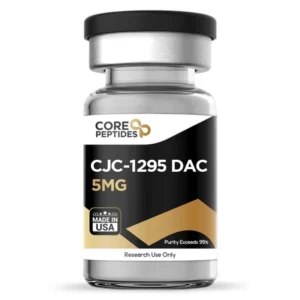
CJC-1295 DAC (with Drug Affinity Complex) 5mg
€46.80
CJC 1295 DAC For Sale — Proven Long-Acting GHRH Research Peptide 5mg
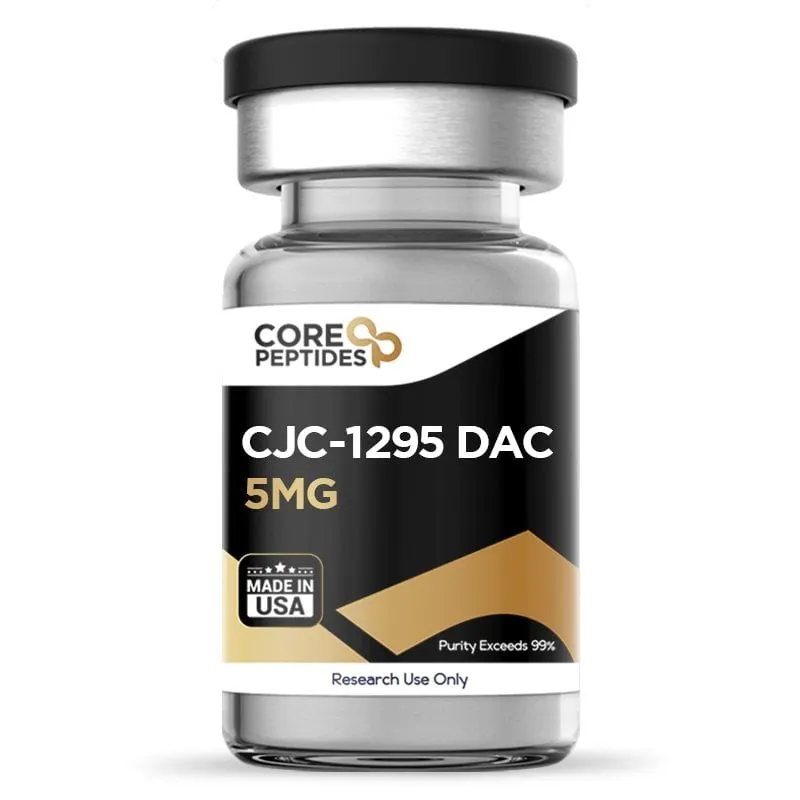
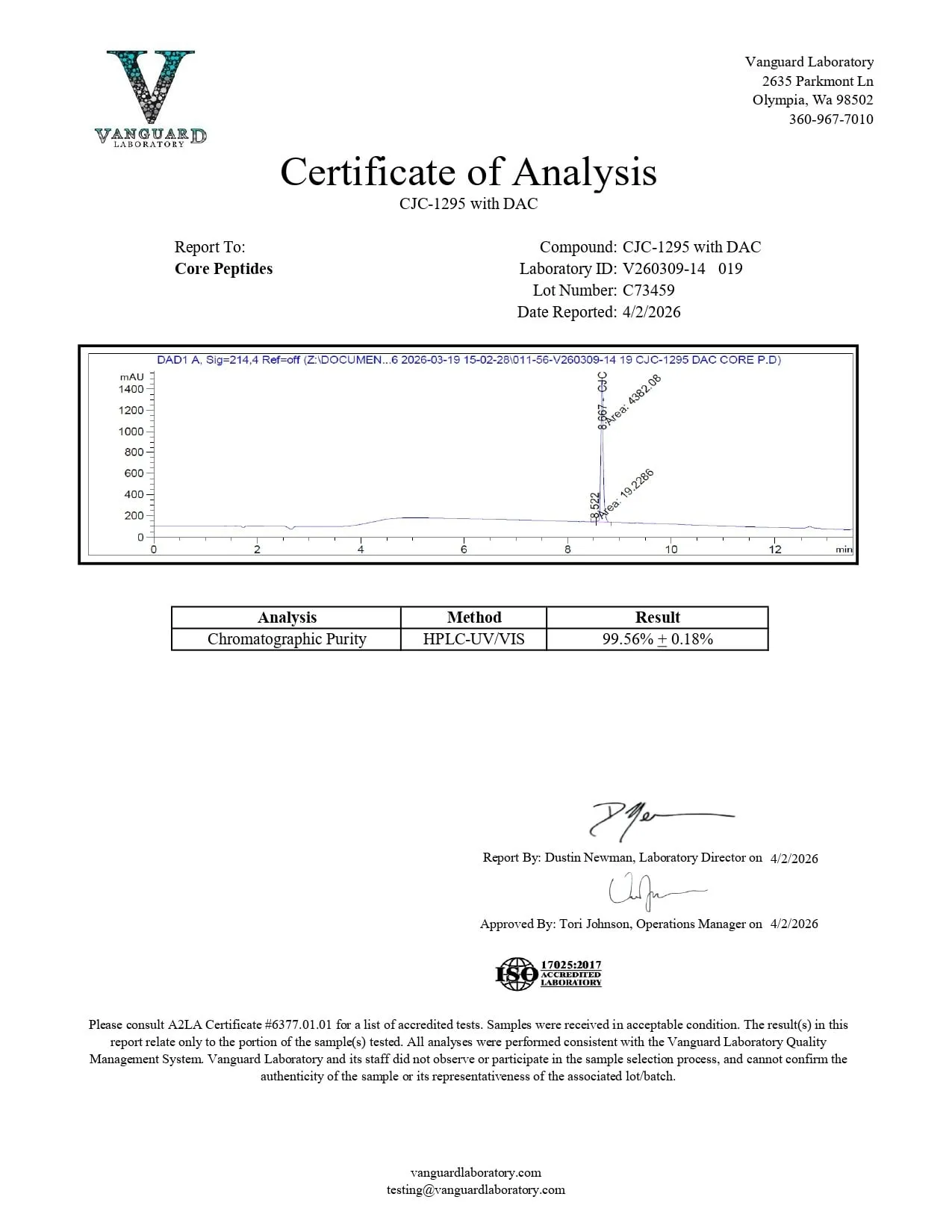
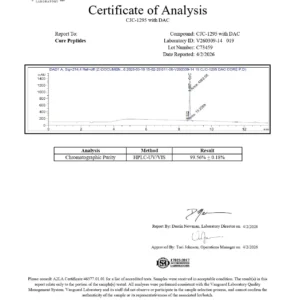
CJC 1295 DAC for sale in research-grade form is a synthetic 29-amino-acid analogue of growth hormone-releasing hormone — modified through four amino acid substitutions and the addition of a Drug Affinity Complex (DAC) to produce one of the longest-acting GHRH analogues available for in-vitro scientific investigation. The DAC component extends the peptide’s effective half-life to approximately 8 days through plasma protein albumin binding — a pharmacokinetic characteristic that fundamentally distinguishes it from CJC-1295 without DAC and makes it the appropriate research tool for protocols examining sustained rather than pulsatile GH axis stimulation. Supplied as a lyophilised powder in a single 5mg vial with a verified purity of >99%.
⚠️ Research Use Only. This product is intended exclusively for in-vitro scientific research. It is not approved for human or animal consumption, clinical use, or therapeutic application.
Table of Contents
- Product Specifications
- GHRH Analogue Architecture
- DAC Technology and Extended Half-Life
- CJC-1295 With DAC vs Without DAC
- Research Applications
- Reconstitution and Storage
- FAQ
Product Specifications
| Parameter | Detail |
|---|---|
| Peptide | CJC-1295 with DAC |
| Classification | GHRH Analogue / GH Secretagogue |
| Amino Acids | 29 |
| DAC Component | N-epsilon-3-maleimidopropionamide (C-terminus) |
| Quantity | 5mg |
| Unit | 1 Vial |
| Form | Lyophilised powder |
| Purity | >99% |
| Approximate Half-Life | ~8 days (with DAC) |
| SKU | P-CJC1295-5 |
GHRH Analogue Architecture
CJC-1295 DAC is derived from GHRH (1-29) — the first 29 amino acids of native growth hormone-releasing hormone — identified in research as the shortest functional fragment retaining the capacity to trigger GH release from pituitary somatotroph cells. This 29-amino-acid sequence represents the active core of the full 44-amino-acid GHRH molecule.
Four of the original 29 amino acids in this sequence are substituted in CJC-1295 DAC — modifications designed to improve the pharmacokinetics of the base peptide and extend its half-life relative to unmodified GHRH (1-29), which is rapidly degraded by circulating dipeptidyl peptidase-4 (DPP-4) and other proteases.
These four substitutions — the tetrasubstitution that defines the CJC-1295 series — improve metabolic stability while maintaining significant affinity for GHRH receptors on pituitary somatotrophs. The result is a structurally stable GHRH analogue that retains its receptor engagement capacity across a pharmacologically relevant timeframe even before the DAC component is applied.
DAC Technology and Extended Half-Life
The defining feature of buy cjc 1295 dac research compounds — relative to all other GHRH analogues — is the Drug Affinity Complex component that gives the molecule its distinctive pharmacokinetic profile.
The DAC component involves the attachment of a modified lysine derivative — specifically N-epsilon-3-maleimidopropionamide — to the C-terminus of the CJC-1295 peptide. This maleimide-bearing modification enables the peptide to form a covalent bond with cysteine-34 of serum albumin — the most abundant plasma protein in circulation.
The albumin-binding mechanism produced by the DAC achieves two critical pharmacokinetic effects. First, it protects the peptide from enzymatic degradation by shielding it within the albumin complex during circulation. Second, the albumin-bound fraction acts as a slow-release reservoir — gradually releasing the peptide into the active, receptor-engaging free form over an extended period.
The combined effect extends the half-life of cjc-1295 dac for sale preparations to approximately 8 days — compared to hours for CJC-1295 without DAC and minutes for unmodified native GHRH. This extended half-life is the primary pharmacokinetic distinction that drives its research selection for sustained GH axis stimulation protocols.
CJC-1295 With DAC vs Without DAC
The research choice between cjc 1295 with dac and CJC-1295 without DAC depends entirely on the GH release pattern required by the research protocol.
CJC-1295 with DAC produces sustained, continuous GH axis stimulation over approximately 8 days — appropriate for research examining the effects of prolonged, consistent GH elevation on downstream biological processes. The continuous stimulation pattern sacrifices GH pulsatility — the natural pattern of pulsed GH release — in favour of sustained receptor engagement.
CJC-1295 without DAC (Mod GRF 1-29) produces an acute, pulsatile GH release that clears within hours — more closely mimicking physiological GH secretion patterns. This is preferred for research where preservation of GH pulsatility is a primary variable.
Neither variant is inherently superior — the appropriate choice is determined by the specific research question being investigated.
Research Applications
CJC-1295 DAC is investigated within the following approved in-vitro research domains:
- Sustained GHRH receptor agonism and GH secretion research
- Extended half-life pharmacokinetic investigation
- IGF-1 axis modulation under sustained GH stimulation
- Albumin binding and plasma protein interaction studies
- Comparative sustained vs pulsatile GH release research
- Anabolic signalling pathway investigation
- Body composition and metabolic rate research
- Sleep architecture and neuroendocrine regulation studies
- Tissue repair mechanism research under GH axis stimulation
Reconstitution and Storage
Reconstitute with sterile or bacteriostatic water. Add solvent slowly along the vial wall and allow to dissolve by gentle rotation. Do not shake or vortex. Store lyophilised powder at −20°C. Once reconstituted, maintain at 4°C and use within the timeframe specified by your research protocol. Protect from light and avoid repeated freeze-thaw cycles.
Explore additional GHRH analogue and GH secretagogue research compounds in our Anti-Age, Muscle Growth and Weight Loss research categories.
FAQ
What is CJC 1295 DAC for sale? CJC 1295 DAC for sale is a synthetic 29-amino-acid GHRH analogue modified through four amino acid substitutions and the addition of a Drug Affinity Complex. The DAC component — N-epsilon-3-maleimidopropionamide attached at the C-terminus — enables albumin binding in plasma, extending the effective half-life to approximately 8 days. This makes it the research tool of choice for sustained GH axis stimulation protocols. Supplied as a 5mg lyophilised powder with >99% purity for in-vitro scientific research.
What is the difference between CJC 1295 with DAC and without DAC? CJC 1295 with DAC produces sustained, continuous GH axis stimulation over approximately 8 days through albumin binding. CJC-1295 without DAC (Mod GRF 1-29) produces an acute, pulsatile GH release that clears within hours — more closely mimicking physiological GH secretion patterns. The choice between them is determined by whether the research protocol requires sustained or pulsatile GH axis engagement.
Where can I buy CJC 1295 DAC for research? Buy CJC 1295 DAC options are available through specialist research peptide suppliers. This compound is supplied strictly for in-vitro scientific research. It is not approved for human consumption, therapeutic use or clinical application. Researchers should ensure compliance with all applicable institutional and regulatory requirements.
Is CJC-1295 DAC for sale appropriate for pulsatile GH research? CJC-1295 dac for sale is not the appropriate format for research requiring pulsatile GH release patterns. The DAC modification produces sustained, continuous GHRH receptor engagement rather than the acute, pulsatile stimulation pattern produced by CJC-1295 without DAC. For pulsatile GH research, Mod GRF 1-29 / CJC-1295 No DAC is the more mechanistically appropriate research tool.
How does the DAC component extend CJC-1295’s half-life? The DAC component — a maleimide-bearing lysine derivative at the C-terminus — enables the peptide to form a covalent bond with cysteine-34 of serum albumin. This albumin binding shields the peptide from proteolytic degradation and creates a slow-release reservoir that gradually releases the active peptide form over approximately 8 days. Without DAC, CJC-1295 has a half-life measured in hours rather than days.
Be the first to review “CJC-1295 DAC (with Drug Affinity Complex) 5mg”
Related products
Weight Loss Research
Core Peptides
Longevity and Anti-aging Research
Weight Loss Research
Particle Peptides
Cognitive Enhancement Research
Cognitive Enhancement Research
Immunity Enhancement Research
Reviews
There are no reviews yet.