

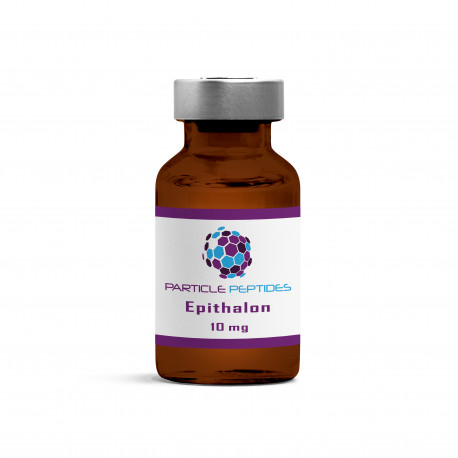
Epithalon 10mg
€41.99
Epithalon 10mg — Proven Telomerase-Activating Anti-Age Peptide
Epithalon 10mg is a synthetic tetrapeptide derived from epithalamine — the bovine pineal gland extract from which its active sequence was identified. Considered a potential activator of telomerase, the enzyme responsible for maintaining and extending the protective telomere caps at the ends of eukaryotic chromosomes, this compound has become one of the most extensively investigated short regulatory peptides in longevity and anti-aging research. Supplied as a lyophilised white powder in a single 10mg vial with a verified purity of ≥98%, this compound is formulated to the standards required for in-vitro scientific research.
⚠️ Research Use Only. This product is intended exclusively for in-vitro scientific research. It is not approved for human or animal consumption, clinical use, or therapeutic application.
Table of Contents
- Product Specifications
- Telomere Biology and Research Context
- Mechanism of Action — Telomerase Activation
- Additional Research Properties
- Research Applications
- Reconstitution and Storage
- FAQ
Product Specifications
| Parameter | Detail |
|---|---|
| Peptide | Epithalon |
| Quantity | 10mg |
| Unit | 1 Vial |
| Physical Appearance | White powder |
| Salt Form | Acetate |
| Peptide Purity | ≥98% |
| Molecular Mass | 390.35 Da |
| CAS Number | 307297-39-8 |
| Solubility | Sterile / Bacteriostatic water — 2.5ml/vial |
| Sequence | Ala-Glu-Asp-Gly |
Telomere Biology and Research Context
To fully appreciate the research significance of epithalon, it is essential to understand the biology of telomeres — the repetitive DNA sequences that cap the ends of eukaryotic chromosomes and protect them from degradation and inappropriate recombination.
Telomeres function as biological clocks. With each cell division, a portion of the telomere sequence is lost — a process that continues until the telomere reaches a critically short length, at which point cells enter senescence or apoptosis. This telomere shortening process is a primary molecular mechanism underlying cellular aging and has been implicated in the pathophysiology of age-related disease.
Telomerase is the specialised enzyme that can add telomeric DNA repeats back to chromosome ends — effectively counteracting the shortening that occurs with each division. In most somatic cells, telomerase activity is minimal or absent. Research into compounds capable of activating telomerase — such as epithalon — is therefore a direct investigation into the molecular mechanisms of aging and potential life extension biology.
Mechanism of Action — Telomerase Activation
Epithalon is considered a potential activator of telomerase — the enzyme that maintains telomere length by adding DNA repeats to chromosome ends. Research has examined the compound’s capacity to upregulate telomerase expression and activity in cell lines, with telomere lengthening observed as a downstream effect in multiple preclinical studies.
As a short regulatory peptide derived from the pineal gland extract epithalamine, epithalon 10mg is hypothesised to operate through gene regulatory mechanisms — modulating the expression of telomerase and related anti-aging genes rather than directly enzymatic action. This regulatory approach is consistent with the broader class of short regulatory peptides derived from organ-specific extracts, of which the Khavinson peptide series is the most extensively documented.
Additional Research Properties
Beyond telomerase activation and telomere maintenance, research has characterised additional properties of epithalon across several biological domains.
Anti-tumor research has examined the compound’s capacity to inhibit tumour cell proliferation and support DNA integrity maintenance — properties mechanistically connected to its telomere biology activity.
DNA activation research has investigated whether epithalon influences gene expression patterns beyond telomerase — including potential effects on the expression of gerontogenes, DNA repair mechanisms and apoptotic pathway regulation.
Skin cell regenerative properties have also been investigated, with research examining whether the compound’s gene regulatory activity extends to dermal cell renewal and ECM maintenance — an area of intersection between its anti-aging and tissue regeneration research profiles.
Research Applications
Epithalon is investigated within the following approved in-vitro research domains:
- Telomerase activation and telomere length maintenance studies
- Chromosomal integrity and DNA repair research
- Anti-aging cellular mechanism investigation
- Longevity biology and life extension research
- Anti-tumor and cancer biology studies
- DNA gene regulatory mechanism research
- Skin cell regeneration and ECM biology
- Pineal gland peptide pharmacology
- Immune system modulation investigation
Reconstitution and Storage
Reconstitute with sterile or bacteriostatic water at 2.5ml per vial. Add solvent slowly along the vial wall and allow to dissolve by gentle rotation. Do not shake or vortex.
Store lyophilised powder at −20°C. Once reconstituted, maintain at 4°C and use within the timeframe specified by your research protocol. Protect from light and avoid repeated freeze-thaw cycles.
Explore additional longevity and anti-aging research peptides in our Anti-Age, Immunity and Longevity and Anti-Age research categories.
FAQ
What is epithalon 10mg? Epithalon 10mg is a synthetic tetrapeptide (Ala-Glu-Asp-Gly) derived from epithalamine — the bovine pineal gland extract from which its active sequence was identified. Considered a potential telomerase activator, it is primarily researched for its capacity to maintain and extend telomere length in eukaryotic cells — addressing a primary molecular mechanism of cellular aging. Supplied as a lyophilised white powder with ≥98% purity for in-vitro scientific research.
What is epithalamin supplement and how does it relate to epithalon? Epithalamin is the bovine pineal gland extract from which epithalon was derived. Epithalamin supplement refers to the broader extract formulation, while epithalon specifically refers to the isolated synthetic tetrapeptide sequence Ala-Glu-Asp-Gly identified as its most biologically active component. For in-vitro research purposes, the synthetic tetrapeptide epithalon provides greater structural precision and reproducibility than the broader epithalamin extract. This product is supplied for in-vitro research use only and is not approved as a supplement.
How does epithalon activate telomerase in research models? In research models, epithalon is hypothesised to upregulate telomerase expression and activity through gene regulatory mechanisms — modulating the transcription of telomerase-related genes rather than direct enzymatic interaction. Preclinical studies have observed telomere lengthening as a downstream effect of this activation, supporting the compound’s characterisation as a potential telomerase activator in the in-vitro research context.
What are the anti-tumor research properties of epithalon? Anti-tumor research involving epithalon has examined its capacity to inhibit tumour cell proliferation and support chromosomal DNA integrity — properties mechanistically connected to its telomere maintenance activity. Research has also investigated its potential effects on DNA repair mechanisms and apoptotic pathway regulation in cancer biology contexts. All research is conducted within approved in-vitro frameworks.
What other research properties does epithalon have beyond telomere biology? Beyond telomerase activation, epithalon research has characterised anti-tumor properties, DNA activation and gene regulatory effects, skin cell regenerative potential in dermal tissue models, and immune system modulation activity. As a short regulatory peptide derived from pineal gland epithalamine, its gene regulatory activity appears to extend across multiple biological domains — making it a compound of broad research interest in anti-aging and longevity biology.
Be the first to review “Epithalon 10mg”
Related products
Longevity and Anti-aging Research
Longevity and Anti-aging Research
Longevity and Anti-aging Research
Immunity Enhancement Research
Core Peptides
Healing and Regeneration research
Core Peptides
Core Peptides
Reviews
There are no reviews yet.