


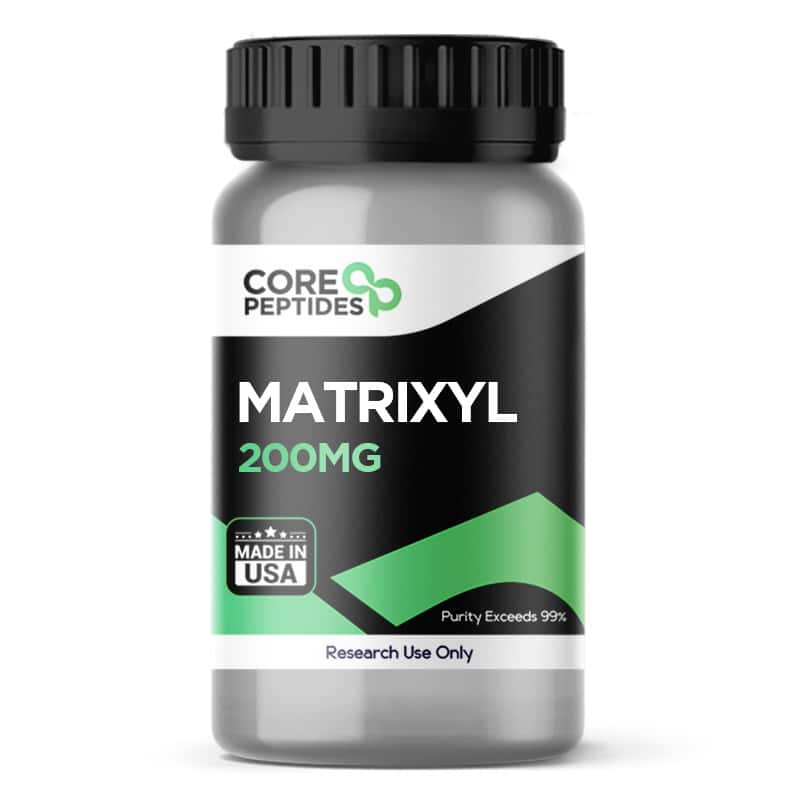
Matrixyl (Palmitoyl Pentapeptide-4) 200mg
€144.90
Palmitoyl Pentapeptide-4 — Proven Collagen Matrikine Research Compound 200mg
Palmitoyl pentapeptide-4 — also widely known as Matrixyl or by the alternative INCI designation palmitoyl pentapeptide-3 — is a synthetic pentapeptide conjugated with a palmitoyl fatty acid chain, currently under scientific investigation for its potential to stimulate collagen production in skin tissue models. Classified as a matrikine — a category of messenger peptides that may regulate cell activities by interacting with specific cell receptors — this compound addresses the fundamental collagen synthesis biology of dermal fibroblasts. The palmitoyl conjugation enhances skin delivery and improves stability against skin proteases. Supplied as a lyophilised powder in a 200mg vial at >99% purity for in-vitro scientific research.
⚠️ Research Use Only. This product is intended exclusively for in-vitro scientific research. It is not approved for human or animal consumption, clinical use, or therapeutic application.
Table of Contents
- Product Specifications
- Matrikine Classification and Mechanism
- Collagen Biology Research Context
- Palmitoyl Conjugation Benefits
- Skin ECM and Fibroblast Research
- Research Applications
- Reconstitution and Storage
- FAQ
Product Specifications
| Parameter | Detail |
|---|---|
| Compound | Matrixyl (Palmitoyl Pentapeptide-4 / Palmitoyl Pentapeptide-3) |
| Classification | Matrikine / Palmitoylated Synthetic Pentapeptide |
| Modification | N-terminal palmitoyl conjugation |
| Quantity | 200mg |
| Unit | 1 Vial |
| Form | Lyophilised powder |
| Purity | >99% |
| SKU | P-Matrixyl |
Matrikine Classification and Mechanism
Palmitoyl pentapeptide-4 belongs to the matrikine class — a category of messenger peptides derived from or mimicking extracellular matrix components that regulate cell activities by interacting with specific cell receptors. The term “matrikine” reflects these peptides’ origin in or relationship to the extracellular matrix (ECM) — the structural and signalling scaffold surrounding cells in tissue.
Matrikines function as cell signalling molecules that communicate information about the state of the ECM to the cells that maintain it. When the ECM undergoes degradation — whether through normal turnover, aging or tissue damage — matrikine fragments released from degraded matrix components signal to fibroblasts and other cell types to initiate repair and synthesis responses. This represents an elegant biological feedback mechanism: ECM degradation generates the signals that drive ECM renewal.
Matrixyl was designed to mimic this signalling mechanism — providing a synthetic matrikine that activates collagen synthesis responses in dermal fibroblasts through receptor-mediated signalling, independently of actual ECM degradation. The pentapeptide 4 classification reflects its composition of five amino acids in the core peptide sequence.
Collagen Biology Research Context
The research significance of palmitoyl conjugated collagen-stimulating peptides requires understanding the central role of collagen in skin tissue biology and the consequences of its age-related decline.
Collagen is the most abundant protein in the human body and the primary structural protein of the dermis — the dense connective tissue layer beneath the epidermis. It provides the tensile strength, structural support and mechanical resilience of skin tissue. Type I collagen is the predominant dermal collagen, organised into fibril networks that form the load-bearing architecture of the dermis.
Collagen synthesis is performed exclusively by dermal fibroblasts — cells that produce the procollagen precursor, secrete it into the extracellular space and facilitate its assembly into mature collagen fibrils through enzymatic processing. Fibroblast collagen synthesis capacity declines significantly with age — driven by reduced growth factor signalling, increased matrix metalloproteinase activity and progressive changes in fibroblast gene expression associated with cellular aging.
Research examining palmitoyl pentapeptide-4 in the context of this age-related collagen decline investigates whether the matrikine signalling approach can restore or enhance collagen synthesis in aged or stressed fibroblast research models.
Palmitoyl Conjugation Benefits
The palmitoyl modification of Matrixyl is not merely a delivery enhancement — it is a research-relevant structural feature with two distinct contributions to the compound’s investigated biology.
First, skin penetration enhancement. As described for other palmitoylated peptides, the C16:0 fatty acid component provides lipid environment compatibility that facilitates traversal of the stratum corneum — the primary barrier to peptide delivery to deeper dermal fibroblasts. Without this modification, the pentapeptide core would face substantial barrier penetration challenges in tissue models.
Second, protease stability improvement. The palmitoyl pentapeptide 4 configuration introduces steric protection around the peptide backbone that reduces susceptibility to skin surface and dermal protease cleavage. Maintaining peptide integrity through multiple tissue layers is essential for ensuring adequate concentrations reach fibroblast targets in research models. The improved stability of the palmitoylated form provides a more consistent delivery profile for in-vitro and tissue model research.
Skin ECM and Fibroblast Research
The primary in-vitro research focus of palmitoyl pentapeptide-4 involves dermal fibroblast biology — specifically the matrikine receptor-mediated signalling that drives collagen synthesis responses.
Research has examined the compound’s effects on fibroblast collagen gene expression — investigating whether matrikine receptor engagement activates the transcriptional programmes responsible for Type I and Type III procollagen synthesis. Downstream protein synthesis, secretion and extracellular fibril assembly research extends the investigation from gene expression to the full collagen production pathway.
Elastin and glycosaminoglycan synthesis research has also been investigated alongside collagen — examining whether Matrixyl’s matrikine signalling activity extends to other ECM components of relevance to skin tissue quality and mechanical properties.
The skin barrier protective dimension of ECM biology — where collagen network quality influences skin barrier competence — connects the compound’s collagen research profile to broader skin aging and skin protection investigation.
Research Applications
Matrixyl / Palmitoyl Pentapeptide-4 is investigated within the following approved in-vitro research domains:
- Collagen synthesis stimulation in dermal fibroblast models
- Matrikine receptor-mediated cell signalling research
- Type I and Type III collagen gene expression studies
- ECM structural protein production biology
- Elastin and glycosaminoglycan synthesis investigation
- Palmitoyl modification skin penetration research
- Protease stability and peptide delivery research
- Age-related fibroblast function and collagen decline research
- Skin aging and ECM quality investigation
Reconstitution and Storage
Reconstitute following standard lyophilised peptide protocols appropriate to your research application. Note: the palmitoyl modification may affect aqueous solubility. Store lyophilised powder at −20°C. Once reconstituted, maintain at 4°C and protect from light. Avoid repeated freeze-thaw cycles.
Explore additional skin biology and anti-aging research compounds in the Longevity and Anti-aging Research and Healing and Regeneration Research categories.
FAQ
What is palmitoyl pentapeptide-4? Palmitoyl pentapeptide-4 — also known as Matrixyl or palmitoyl pentapeptide-3 — is a synthetic matrikine peptide conjugated with a palmitoyl fatty acid for enhanced skin delivery. It is researched for its potential to stimulate collagen production in dermal fibroblasts through matrikine receptor-mediated signalling — mimicking the natural ECM degradation signals that trigger collagen synthesis repair responses. Supplied as a 200mg lyophilised powder with >99% purity for in-vitro scientific research.
What is pentapeptide 4 in cosmetic research contexts? Pentapeptide 4 refers to the five-amino-acid core peptide sequence of Matrixyl — before palmitoylation. In cosmetic research contexts, pentapeptide 4 and palmitoyl pentapeptide-4 are sometimes used interchangeably, though the palmitoylated form is the research-active preparation with enhanced skin penetration properties. This compound is supplied for in-vitro scientific research only — not as a cosmetic ingredient for direct topical application.
What is palmitoyl and why is it conjugated to pentapeptide-4? Palmitoyl refers to the palmitoyl group — derived from palmitic acid, a 16-carbon saturated fatty acid. Its conjugation to pentapeptide-4 serves two research purposes: enhancing skin tissue penetration by providing lipid environment compatibility with the stratum corneum barrier, and improving stability against skin surface and dermal protease enzymes. Without the palmitoyl modification, the peptide core faces significant penetration and stability limitations in skin tissue research models.
What is a matrikine and how does Matrixyl function as one? A matrikine is a messenger peptide that regulates cell activities by interacting with specific cell receptors — typically mimicking the signalling fragments released during ECM degradation. Matrixyl functions as a matrikine by activating fibroblast receptors in a manner that mimics the natural degradation signals that trigger collagen synthesis repair responses. By engaging these receptors without actual ECM degradation, it provides a pharmacological tool for investigating collagen synthesis stimulation through the natural matrikine receptor-signalling pathway.
What is the research significance of the 200mg Matrixyl format? The 200mg format provides a substantially larger research supply than standard small-vial peptide formats — appropriate for large-scale cell culture studies, multiple experimental series, extended research programmes or formulation research requiring larger working quantities. Matrixyl’s established role in collagen biology research means sustained investigation programmes benefit from the batch consistency that the 200mg format provides across multiple experimental timepoints.
Be the first to review “Matrixyl (Palmitoyl Pentapeptide-4) 200mg”
Related products

Core Peptides

Longevity and Anti-aging Research
Core Peptides
Core Peptides
Core Peptides
Longevity and Anti-aging Research
Healing and Regeneration research
Core Peptides
Reviews
There are no reviews yet.