
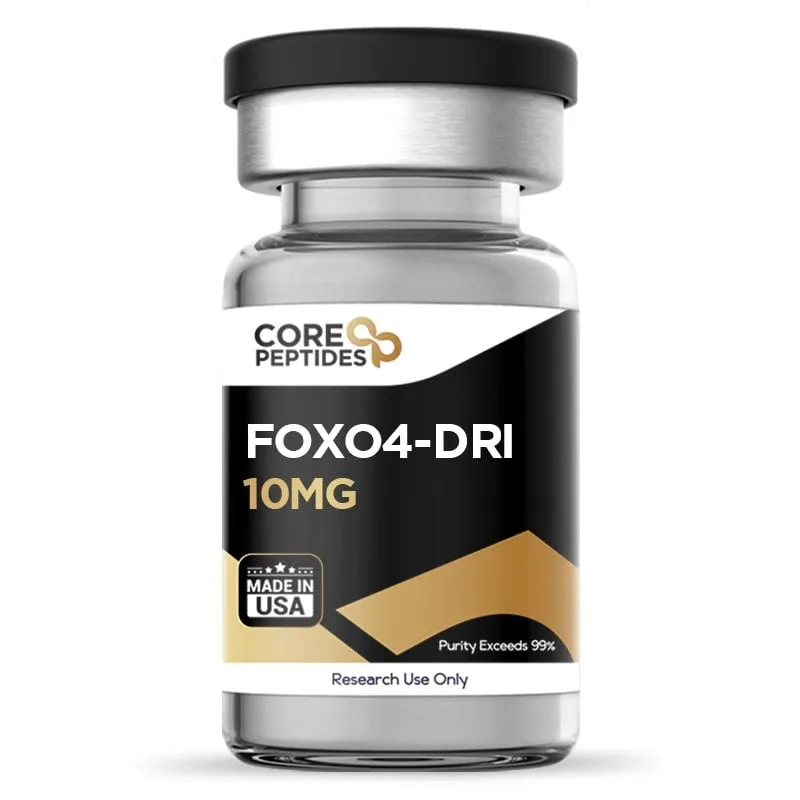
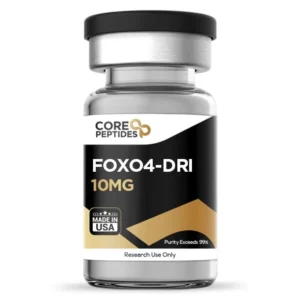
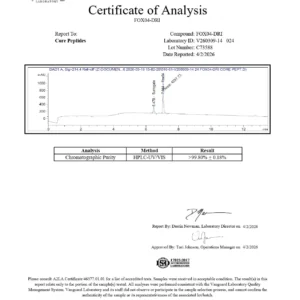
FOXO4-DRI (Proxofim) 10mg
€211.00
FOXO4-DRI Peptide 10mg — Proven Senolytic p53 Research Compound
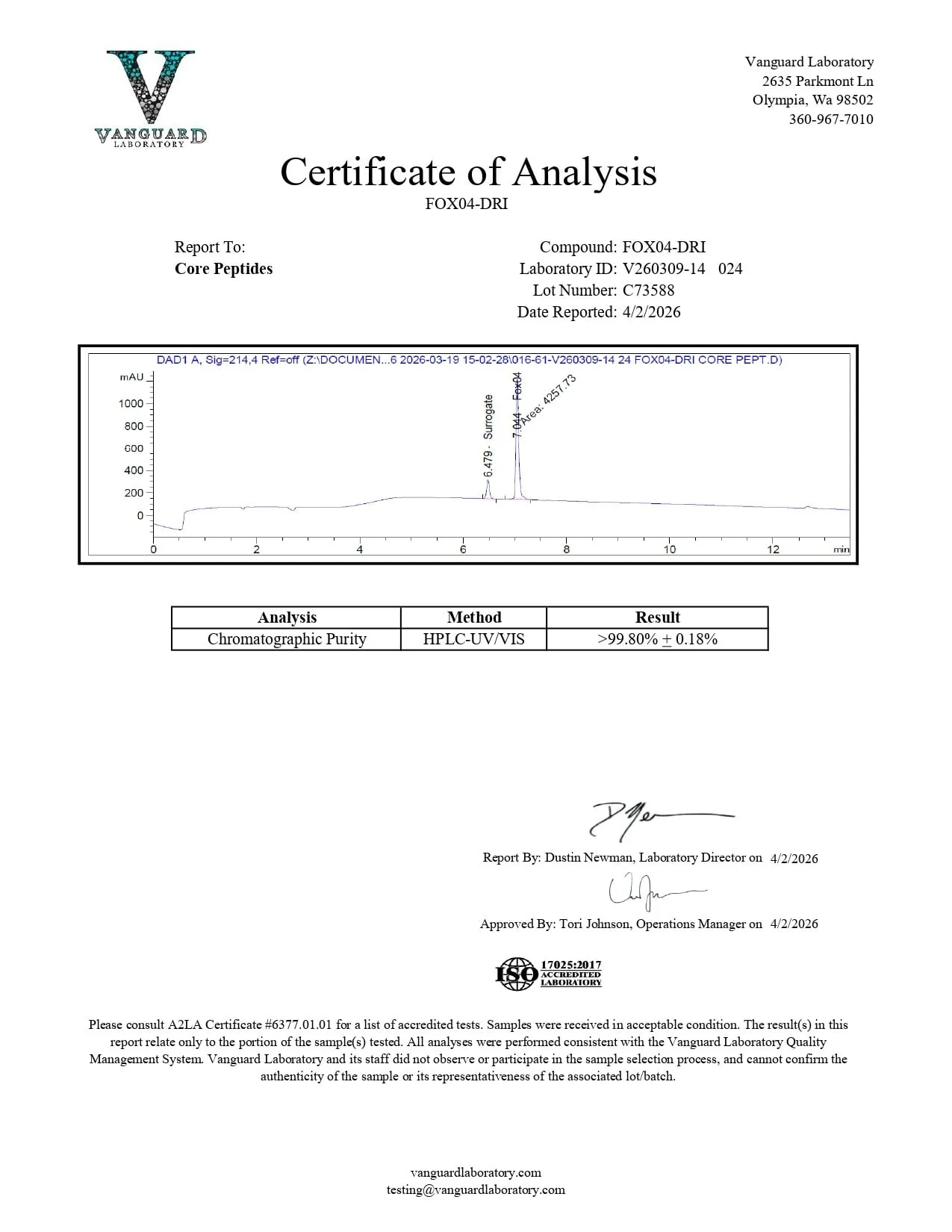
FOXO4-DRI peptide — also known as Proxofim, a name derived from its full designation as Forkhead Box O transcription factor 4-D-Retro-Inverso peptide — is a synthetic senolytic research compound engineered to selectively disrupt the FOXO4-p53 protein interaction in senescent cells. Developed to be structurally identical to a specific fragment of the endogenous FOXO4 protein crucial for p53 interaction, but with L-amino acids replaced by D-amino acids throughout, this retro-inverso architecture confers both enhanced proteolytic stability and modified cellular interaction properties relative to the native sequence. Supplied as a lyophilised powder in a single 10mg vial with a verified purity of >99% for in-vitro scientific research.
⚠️ Research Use Only. This product is intended exclusively for in-vitro scientific research. It is not approved for human or animal consumption, clinical use, or therapeutic application.
Table of Contents
- Product Specifications
- FOXO Transcription Factor Family Biology
- D-Retro-Inverso Architecture
- FOXO4-p53 Interaction and Senescent Cell Survival
- Senolytic Mechanism Research
- Research Applications
- Reconstitution and Storage
- FAQ
Product Specifications
| Parameter | Detail |
|---|---|
| Peptide | FOXO4-DRI (Proxofim) |
| Full Name | Forkhead Box O Transcription Factor 4-D-Retro-Inverso Peptide |
| Classification | Synthetic Senolytic / D-Retro-Inverso Peptide |
| Amino Acid Structure | D-amino acid substituted FOXO4 fragment |
| Quantity | 10mg |
| Unit | 1 Vial |
| Form | Lyophilised powder |
| Purity | >99% |
| SKU | P-FOXO4-10 |
FOXO Transcription Factor Family Biology
FOXO4-DRI peptide research cannot be fully contextualised without understanding the biological role of the FOXO protein family from which it is derived. FOXO transcription factors — also designated the forkhead family of transcription factor-O proteins — comprise four members in mammals: FOXO1, FOXO3, FOXO4 and FOXO6.
These transcription factors regulate an extensive range of cellular processes — including insulin signalling pathway integration, cell cycle progression control, stress response regulation, and the modulation of growth and differentiation programmes. Their activity is tightly regulated by post-translational modifications, particularly phosphorylation by the PI3K/AKT pathway, which controls their nuclear localisation and transcriptional activity.
FOXO4 specifically is considered to regulate insulin signalling, cell cycle checkpoints and various growth and differentiation functions. Its particular relevance to senescence biology — and therefore to the research context of fox04-dri — lies in its role in the survival of senescent cells, where it forms a protective complex with the tumour suppressor protein p53 that prevents these cells from undergoing the apoptosis they would otherwise face.
D-Retro-Inverso Architecture
The structural designation “DRI” in foxo4 peptide research describes the D-Retro-Inverso modification strategy — one of the most sophisticated approaches to peptide stability engineering available.
This architecture replaces every L-amino acid in the peptide sequence with its D-amino acid stereoisomeric counterpart — mirror-image versions of the natural amino acids that are not recognised by standard proteolytic enzymes. The result is a peptide sequence that is essentially invisible to the normal clearance mechanisms that rapidly degrade L-amino acid peptides in biological environments.
This D-amino acid substitution not only dramatically enhances proteolytic stability — extending the peptide’s effective research window — but also modifies how it interacts with other cellular components compared to the natural FOXO4 sequence. These altered interaction properties are mechanistically relevant to its senolytic activity, and represent an important research consideration when designing protocols using this compound.
The fox04 dri architecture represents one of the most structurally sophisticated approaches to creating a stable, cell-penetrating senolytic peptide — combining the molecular recognition properties of a specific FOXO4 protein fragment with the pharmacokinetic advantages of full D-amino acid composition.
FOXO4-p53 Interaction and Senescent Cell Survival
The specific cellular mechanism targeted by foxo4 peptide for sale research compounds is the interaction between FOXO4 and p53 — the tumour suppressor protein central to apoptosis induction.
In senescent cells — cells that have permanently exited the cell cycle in response to DNA damage, oxidative stress or other stress signals — FOXO4 forms a protective complex with p53 within the nucleus. This FOXO4-p53 interaction sequesters p53 in a conformation that prevents it from initiating the pro-apoptotic transcriptional programme it would otherwise activate. The consequence is that senescent cells become apoptosis-resistant — unable to undergo the programmed cell death that would normally clear them from tissue.
This FOXO4-mediated p53 sequestration is considered a primary mechanism by which senescent cells persist indefinitely in tissue, accumulating over time and contributing to the chronic inflammatory environment — the Senescence-Associated Secretory Phenotype (SASP) — that drives age-related tissue dysfunction.
Senolytic Mechanism Research
FOXO4-DRI functions as a competitive inhibitor of the FOXO4-p53 interaction — binding p53 at the FOXO4 interaction site and displacing endogenous FOXO4 from the complex. This competitive disruption releases p53 from its sequestered state, allowing it to activate the pro-apoptotic gene expression programme and initiate apoptosis in senescent cells.
Critically, the selectivity of this mechanism is a primary research focus. In healthy, non-senescent cells, the FOXO4-p53 interaction is not constitutively active in the same manner as in senescent cells — meaning FOXO4-DRI is proposed to preferentially target cells where this interaction is driving apoptosis resistance. Research examining this proposed selectivity — and whether healthy tissue is spared from the apoptotic effects — is central to understanding the compound’s potential utility as a research tool for senolytic biology.
The compound also modulates multiple regulatory pathways in senescent cells — including insulin signalling (reflecting FOXO4’s role in this system), cell cycle control (reflecting p53’s G1/S checkpoint function) and oxidative stress response pathways.
Research Applications
FOXO4-DRI is investigated within the following approved in-vitro research domains:
- FOXO4-p53 protein-protein interaction disruption research
- Selective senescent cell apoptosis investigation
- SASP elimination and tissue microenvironment research
- FOXO transcription factor biology and signalling
- D-retro-inverso peptide pharmacology and stability research
- Insulin signalling and PI3K/AKT pathway investigation
- Cell cycle control and p53 regulatory pathway research
- Oxidative stress response and senescence biology
- Biological aging deceleration mechanism investigation
Reconstitution and Storage
Reconstitute with bacteriostatic water. Add solvent slowly along the vial wall and allow to dissolve by gentle rotation. Do not shake or vortex. Store lyophilised powder at −20°C. Once reconstituted, maintain at 4°C and use within the timeframe specified by your research protocol. Protect from light and avoid repeated freeze-thaw cycles.
Explore additional senolytic and anti-aging research compounds in our Immunity, Healing and Anti-Age research categories.
FAQ
What is FOXO4-DRI peptide? FOXO4-DRI peptide — also known as Proxofim — is a synthetic D-retro-inverso peptide representing a specific fragment of the FOXO4 transcription factor sequence crucial for p53 interaction, with all L-amino acids replaced by D-amino acids. Its primary investigated function is competitive disruption of the FOXO4-p53 interaction in senescent cells — releasing p53 to initiate apoptosis and selectively eliminating cells that resist normal programmed cell death. Supplied as a 10mg lyophilised powder with >99% purity for in-vitro scientific research.
What is fox04-dri and how does the naming work? Fox04-dri is a common search variant where the letter “O” in FOXO4 is replaced with the number “0” — both refer to the same compound. FOXO4-DRI stands for Forkhead Box O transcription factor 4-D-Retro-Inverso peptide. The “DRI” designation specifies the D-amino acid retro-inverso architecture that confers proteolytic stability and modified cellular interaction properties relative to the native FOXO4 sequence.
What is fox04 dri’s mechanism of action? Fox04 dri acts as a competitive inhibitor of the FOXO4-p53 protein interaction in senescent cells. In senescent cells, FOXO4 sequesters p53 to prevent apoptosis induction — allowing cells to persist indefinitely. FOXO4-DRI competes with endogenous FOXO4 for p53 binding, displacing the interaction and releasing p53 to activate its pro-apoptotic transcriptional programme. The D-retro-inverso structure enhances stability by resisting normal proteolytic degradation mechanisms.
What is foxo4 peptide for sale used for in research? Foxo4 peptide for sale is used in approved in-vitro research examining FOXO4-p53 interaction disruption, selective senescent cell apoptosis, SASP biology and tissue microenvironment restoration, FOXO transcription factor signalling, D-retro-inverso peptide pharmacology, insulin and PI3K/AKT pathway investigation, p53 cell cycle regulatory research and biological aging mechanism investigation. All applications are within approved in-vitro research frameworks.
What is the FOXO4 transcription factor and why is it relevant to senescence? FOXO4 is a member of the forkhead family of O-class transcription factors — proteins that regulate insulin signalling, cell cycle progression and growth and differentiation. Its senescence relevance lies in its capacity to form a protective complex with p53 in senescent cells, sequestering the pro-apoptotic tumour suppressor and preventing cell death. This FOXO4-mediated apoptosis resistance allows senescent cells to accumulate in tissue over time — contributing to the chronic SASP inflammatory environment associated with age-related tissue dysfunction.
Be the first to review “FOXO4-DRI (Proxofim) 10mg”
Related products
Longevity and Anti-aging Research
Cognitive Enhancement Research
Cognitive Enhancement Research
Immunity Enhancement Research
Healing and Regeneration research
Longevity and Anti-aging Research

Longevity and Anti-aging Research
Healing and Regeneration research
Reviews
There are no reviews yet.