
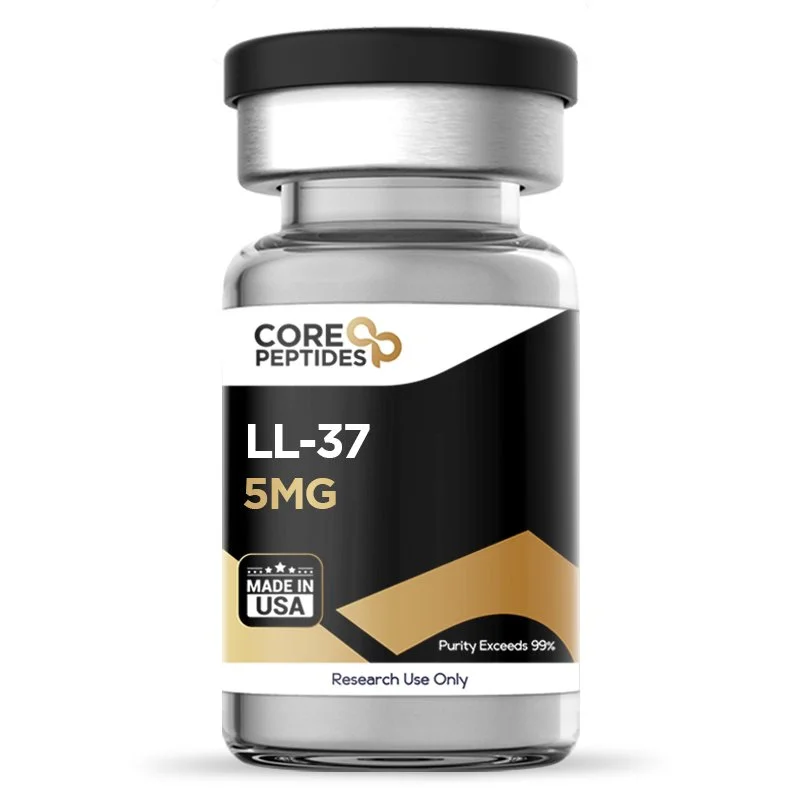
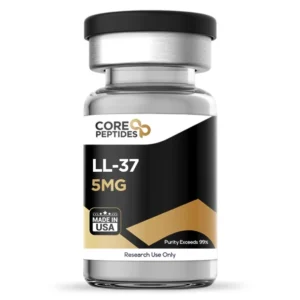
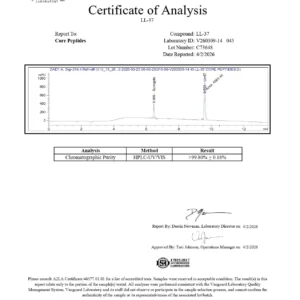
LL-37 (Cathelicidin) 5mg
€67.50
LL-37 For Sale — Proven Cathelicidin Research Peptide 5mg
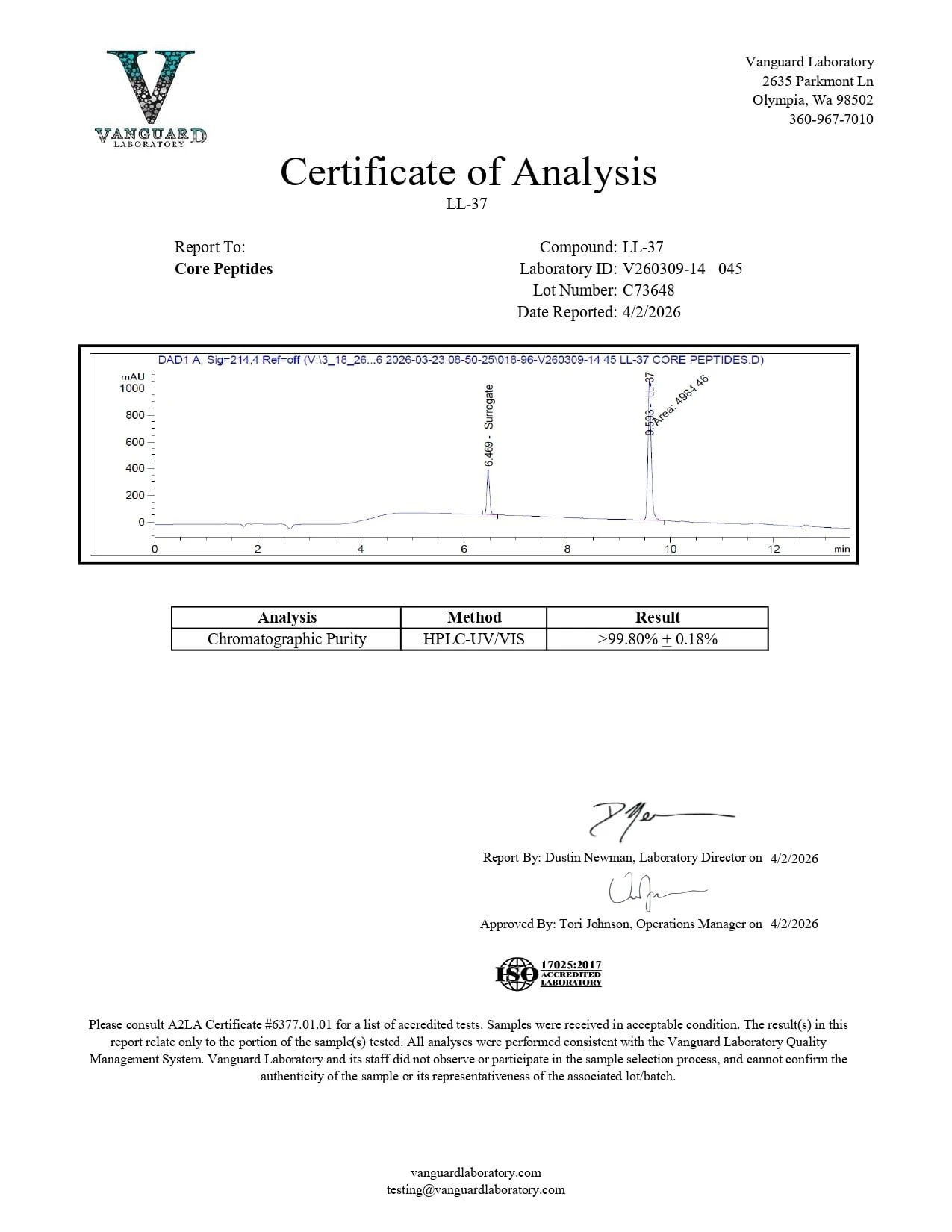
LL-37 for sale in research-grade form — also designated Cathelicidin or CAP-18 — is the only known human cathelicidin: a cationic antimicrobial peptide composed of 37 amino acids, primarily found in neutrophils and produced through extracellular breakdown of the hCAP18 precursor protein by protease enzymes. Its cationic character and amphipathic helix structure underpin its antimicrobial mechanism — enabling selective interaction with negatively charged bacterial membranes while exhibiting protection against its own degradation through agglomerate and lipid bilayer formation. Intensive biomedical research has established LL-37’s significance across innate immunity, wound healing, autoimmune disease and cancer biology. Supplied as a lyophilised powder in a single 5mg vial at >99% purity for in-vitro scientific research.
⚠️ Research Use Only. This product is intended exclusively for in-vitro scientific research. It is not approved for human or animal consumption, clinical use, or therapeutic application.
Table of Contents
- Product Specifications
- Cathelicidin Biology and hCAP18 Processing
- Structural Basis of Antimicrobial Activity
- Agglomerate Formation and Degradation Resistance
- Immunomodulatory and Anti-Inflammatory Research
- Cancer and Autoimmune Research
- Wound Healing Research
- Research Applications
- Reconstitution and Storage
- FAQ
Product Specifications
| Parameter | Detail |
|---|---|
| Peptide | LL-37 (Cathelicidin / CAP-18) |
| Classification | Human Cathelicidin / Cationic Antimicrobial Peptide |
| Amino Acids | 37 |
| Primary Source | Neutrophils |
| Precursor | hCAP18 protein |
| Processing | Extracellular protease cleavage |
| Quantity | 5mg |
| Unit | 1 Vial |
| Form | Lyophilised powder |
| Purity | >99% |
| SKU | P-LL37-5 |
Cathelicidin Biology and hCAP18 Processing
LL-37 is produced from the hCAP18 (human Cathelicidin Antimicrobial Protein 18) precursor — a 18 kDa protein stored in secretory granules of neutrophils and expressed in epithelial cells, keratinocytes and other cell types involved in innate immune defence.
The name LL-37 directly describes the mature peptide’s structural features — “LL” for the two leucine residues at the N-terminus of the mature fragment, and “37” for the total amino acid count of the active peptide. This naming convention reflects the direct relationship between structure and designation that is characteristic of the cathelicidin peptide family.
Processing of hCAP18 to the active LL-37 peptide is mediated by extracellular protease enzymes — particularly serine proteases including proteinase 3 and plasmin — that cleave the conserved cathelin domain from the C-terminal antimicrobial domain, releasing ll37 peptide for sale in its active form. This protease-dependent activation mechanism means that LL-37 production is regulated both by hCAP18 expression and by protease availability in the extracellular environment.
Structural Basis of Antimicrobial Activity
The antimicrobial mechanism of buy ll-37 research compounds rests on two structural features — its cationic charge and its amphipathic alpha-helical conformation.
The multiple positively charged amino acid residues distributed throughout the LL-37 sequence create an overall cationic character that enables selective interaction with bacterial membranes. Bacterial membranes are rich in negatively charged phospholipids — particularly phosphatidylglycerol and cardiolipin in gram-positive bacteria — that attract cationic antimicrobial peptides through electrostatic interaction. Mammalian cell membranes, by contrast, are predominantly zwitterionic with cholesterol enrichment that reduces susceptibility to cationic peptide interaction — providing the basis for LL-37’s preferential bacterial membrane targeting.
Upon interaction with bacterial membrane surfaces, LL-37 adopts an amphipathic alpha-helical conformation — one face hydrophilic and positively charged, the opposite face hydrophobic. This amphipathic helical structure enables membrane insertion and disruption through mechanisms including toroidal pore formation, carpet model membrane disintegration and transmembrane pore formation.
Agglomerate Formation and Degradation Resistance
A mechanistically distinctive feature of LL-37 that protects it in biological environments is its capacity to form agglomerates and lipid bilayer associations — a structural behaviour noted in characterisation research.
LL-37 agglomerates are self-associating multimeric forms that may resist enzymatic degradation more effectively than monomeric LL-37. This agglomerate formation provides a degree of protection against the protease-rich environment of inflammatory and infected tissue — extending the effective research activity window of the peptide in biological systems.
The lipid bilayer associations — LL-37’s capacity to interact with and partition into lipid membranes — further contribute to its degradation resistance by shielding portions of the sequence from soluble protease access. These structural properties are relevant to research protocol design for ll37 peptide buy preparations.
Immunomodulatory and Anti-Inflammatory Research
Beyond its direct antimicrobial activity, buy ll-37 peptide research has extensively characterised its immunomodulatory properties — effects on the innate and adaptive immune systems that extend well beyond simple pathogen killing.
Toll-like receptor (TLR) pathway modulation — both activation and inhibition depending on inflammatory context — has been characterised. Chemokine and cytokine expression modulation in neutrophils, macrophages and dendritic cells has been documented. LL-37’s capacity to promote immune cell recruitment to sites of infection and injury represents a pro-inflammatory dimension that works alongside its direct antimicrobial activity to coordinate effective innate immune responses.
Anti-inflammatory modulation has also been characterised in chronic inflammatory contexts — where LL-37’s TLR pathway inhibition and cytokine regulatory effects may contribute to inflammatory resolution rather than escalation. This context-dependent immunomodulation is a mechanistically important research consideration.
Cancer and Autoimmune Research
LL-37’s research profile extends to cancer biology and autoimmune disease — areas where its immunomodulatory and cell signalling properties have mechanistic relevance.
Cancer research has characterised both tumour-suppressive and tumour-promoting activities depending on cancer type — with direct tumour cell apoptosis induction in some cancer cell line models alongside reported tumour-supporting activity in others. Autoimmune disease research has examined LL-37’s role in conditions including lupus erythematosus and psoriasis, where dysregulated LL-37 production contributes to pathological immune activation through self-DNA complex formation and TLR pathway stimulation.
Wound Healing Research
LL-37’s wound healing research profile encompasses its combined antimicrobial, immunomodulatory and keratinocyte-stimulating properties. Research has characterised its capacity to accelerate epithelial repair — stimulating keratinocyte migration and proliferation at wound sites. The simultaneous reduction of microbial load and promotion of epithelial repair makes LL-37 a research compound of interest in chronic wound biology where infection and impaired healing converge.
Research Applications
LL-37 is investigated within the following approved in-vitro research domains:
- Antibacterial membrane disruption and mechanism studies
- Antiviral innate immunity research
- Biofilm formation inhibition and disruption
- TLR pathway activation and inhibition research
- Immunomodulatory cytokine and chemokine regulation
- Neutrophil, macrophage and dendritic cell function
- Cancer cell apoptosis and tumour biology research
- Autoimmune disease pathogenesis investigation
- Wound healing and keratinocyte biology
- hCAP18 processing and cathelicidin activation research
Reconstitution and Storage
Reconstitute with bacteriostatic water at 1ml per vial. LL-37 is an amphipathic peptide that may exhibit self-aggregation at higher concentrations — prepare working solutions at appropriate concentrations for your assay system. Store lyophilised powder at −20°C. Once reconstituted, maintain at 4°C and use promptly. Protect from light and avoid repeated freeze-thaw cycles.
Explore additional antimicrobial and immunity research compounds in the Immunity Enhancement Research and Healing and Regeneration Research categories.
FAQ
What is LL-37 for sale? LL-37 for sale — also known as Cathelicidin or CAP-18 — is the only known human cathelicidin, a cationic 37-amino-acid antimicrobial peptide produced from hCAP18 precursor protein by protease cleavage, primarily found in neutrophils. It exhibits antibacterial, antiviral, immunomodulatory and anti-inflammatory properties across extensive biomedical research. Supplied as a 5mg lyophilised powder with >99% purity for in-vitro scientific research.
Where can I buy LL-37? Buy LL-37 options are available through specialist research peptide suppliers. This compound is supplied strictly for in-vitro scientific research. It is not approved for human consumption, therapeutic use or clinical application. Researchers should ensure compliance with all applicable institutional requirements.
What is ll37 peptide for sale used for in research? LL37 peptide for sale is used in approved in-vitro research examining antibacterial membrane disruption, antiviral innate immunity, biofilm inhibition, TLR pathway modulation, immunomodulatory cytokine regulation, neutrophil and macrophage function, cancer cell apoptosis biology, autoimmune disease pathogenesis, wound healing and keratinocyte biology. All applications are within approved in-vitro frameworks.
How does LL-37 selectively target bacteria over mammalian cells? LL-37’s bacterial membrane selectivity arises from the difference in membrane lipid composition between bacterial and mammalian cells. Bacterial membranes are rich in negatively charged phospholipids that attract LL-37’s cationic charge. Mammalian membranes are predominantly zwitterionic with cholesterol enrichment that reduces susceptibility to cationic peptide disruption. This compositional difference enables LL-37 to preferentially interact with and disrupt bacterial membranes in research models.
What is the significance of LL-37’s agglomerate formation? LL-37’s capacity to form self-associating agglomerates and lipid bilayer associations provides a degree of protection against protease-mediated degradation in biological environments. Agglomerate forms may resist enzymatic cleavage more effectively than monomeric LL-37 — extending the effective research activity window in biological research systems. This structural behaviour is relevant to protocol design considerations for in-vitro research using this compound.
Be the first to review “LL-37 (Cathelicidin) 5mg”
Related products
Healing and Regeneration research
Core Peptides
Immunity Enhancement Research
Healing and Regeneration research
Longevity and Anti-aging Research
Core Peptides
Healing and Regeneration research
Core Peptides
Reviews
There are no reviews yet.