


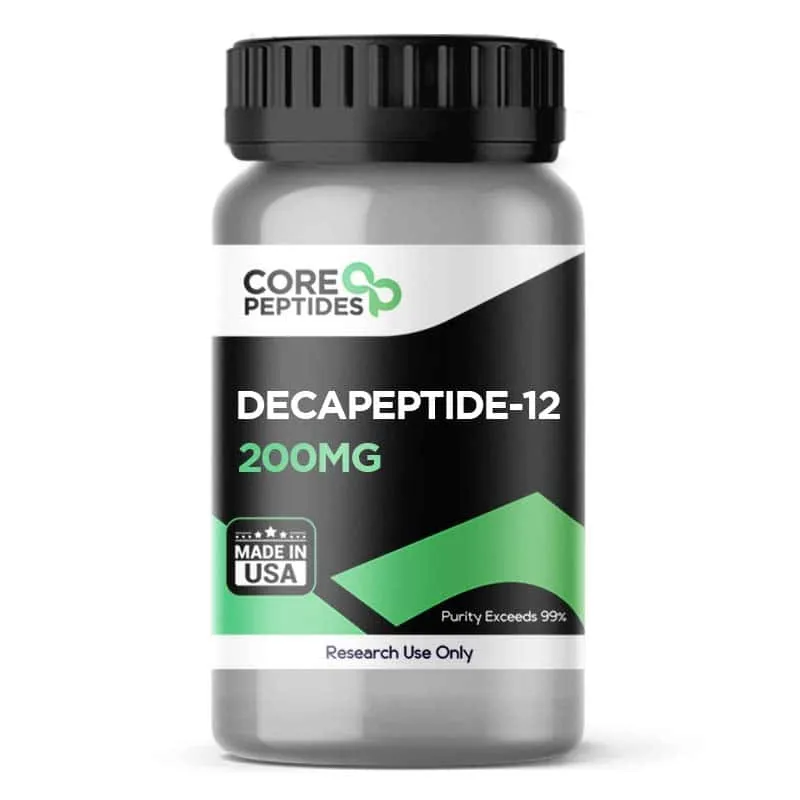
Decapeptide-12 200mg
€216.00
Decapeptide-12 — Proven Tyrosinase Inhibitor Skin Research Compound 200mg
Decapeptide-12 is a wholly synthetic 10-amino-acid peptide — designed and synthesised to exhibit specific biological properties rather than derived from or mimicking any naturally occurring peptide sequence. Its developers and subsequent researchers have characterised it primarily as a potential tyrosinase inhibitor — a compound that may suppress the activity of tyrosinase, the rate-limiting enzyme in the melanin biosynthesis pathway. Research has focussed on applications in reducing melanin production and hyperpigmentation biology, alongside investigation into effects on cell growth, differentiation and cellular aging processes. Supplied as a lyophilised powder in a 200mg vial at >99% purity for in-vitro scientific research.
⚠️ Research Use Only. This product is intended exclusively for in-vitro scientific research. It is not approved for human or animal consumption, clinical use, or therapeutic application.
Table of Contents
- Product Specifications
- Tyrosinase Biology and Melanin Synthesis
- Hyperpigmentation Research Context
- Cell Growth and Differentiation Research
- Anti-Aging Cell Biology Research
- Research Applications
- Reconstitution and Storage
- FAQ
Product Specifications
| Parameter | Detail |
|---|---|
| Peptide | Decapeptide-12 |
| Amino Acids | 10 |
| Classification | Synthetic Tyrosinase Inhibitor Peptide |
| Derivation | De novo designed — no natural counterpart |
| Quantity | 200mg |
| Unit | 1 Vial |
| Form | Lyophilised powder |
| Purity | >99% |
| SKU | P-Decapeptide-12 |
Tyrosinase Biology and Melanin Synthesis
The primary mechanistic research focus of decapeptide 12 peptide involves tyrosinase — the copper-containing enzyme that serves as the rate-limiting catalyst in melanin biosynthesis. Understanding tyrosinase’s role requires understanding the melanogenesis pathway in which it operates.
Melanin is the pigment responsible for skin, hair and eye colouration in humans. Its synthesis occurs in melanocytes — specialised pigment-producing cells distributed primarily in the basal layer of the epidermis. The melanogenesis pathway begins with the amino acid tyrosine, which tyrosinase converts to DOPA (dihydroxyphenylalanine) and subsequently to DOPAquinone — the first committed step in melanin synthesis.
Tyrosinase inhibition at this critical rate-limiting step reduces the downstream production of melanin — making tyrosinase inhibitors a significant research focus in hyperpigmentation biology, dermatological aging research and skin tone regulation investigation.
Decapeptide-12 is researched as a potential tyrosinase inhibitor — a compound that may suppress this enzymatic step and thereby reduce melanin production in research models examining melanocyte biology.
Hyperpigmentation Research Context
The primary applied research direction for decapeptide inhibitor compounds is hyperpigmentation investigation — the study of conditions characterised by localised or diffuse excess melanin production in skin tissue.
Hyperpigmentation encompasses several distinct research contexts. Post-inflammatory hyperpigmentation occurs following skin injury or inflammation — where the inflammatory response stimulates melanocyte activity. Melasma is a hormonally influenced pattern of facial hyperpigmentation. Solar lentigines — commonly referred to as age spots or sun spots — represent UV-stimulated focal melanin accumulation.
Research examining Decapeptide-12’s potential to inhibit tyrosinase activity in these hyperpigmentation contexts investigates whether targeted enzymatic suppression of the melanogenesis pathway can reduce excess pigment production in melanocyte research models — providing mechanistic data relevant to dermatological research and cosmetic biochemistry.
Cell Growth and Differentiation Research
Beyond its primary tyrosinase inhibition research profile, decapeptide-12 has been investigated for effects on cell growth and differentiation — research directions that extend its relevance beyond simple melanin suppression to broader melanocyte and skin cell biology.
Cell growth research has examined whether Decapeptide-12’s activity influences melanocyte proliferation — investigating the relationship between tyrosinase inhibition and melanocyte cell cycle regulation. Cell differentiation research has examined whether the compound’s effects on melanocyte function extend to the differentiation status of melanocyte progenitor cells.
These investigations reflect the interconnected nature of pigmentation biology, cell growth regulation and differentiation — processes that share regulatory pathways in melanocyte biology and are relevant to both basic pigmentation research and dermatological cancer biology where melanocyte differentiation status is a key pathological variable.
Anti-Aging Cell Biology Research
The cellular aging research dimension of Decapeptide-12 investigation connects its skin biology research profile to the broader anti-aging research domain. Melanocyte senescence — the functional exhaustion of melanocyte populations with age — is associated with changes in pigmentation patterns characteristic of aging skin. Tyrosinase activity itself changes with melanocyte aging — contributing to age-associated pigmentation irregularities.
Research examining decapeptide-12‘s effects on mitigating cell aging processes in melanocyte models investigates whether tyrosinase inhibition and the broader biological effects of the compound extend to senescence-associated changes in skin pigmentation biology. This connection between tyrosinase inhibition and cellular aging research positions Decapeptide-12 at the intersection of pigmentation and anti-aging skin cell biology.
Research Applications
Decapeptide-12 is investigated within the following approved in-vitro research domains:
- Tyrosinase inhibition and melanogenesis pathway research
- Melanin production and hyperpigmentation biology
- Melanocyte cell biology and pigmentation regulation
- Post-inflammatory, melasma and solar lentigo research models
- Cell growth and proliferation regulation in melanocyte models
- Melanocyte differentiation and progenitor cell biology
- Anti-aging cell biology and melanocyte senescence research
- Cosmetic biochemistry and skin tone regulation investigation
Reconstitution and Storage
Reconstitute following standard lyophilised peptide protocols appropriate to your research application. Store lyophilised powder at −20°C. Once reconstituted, maintain at 4°C and use within the timeframe specified by your research protocol. Protect from light and avoid repeated freeze-thaw cycles.
Explore additional anti-aging and skin biology research compounds in our Anti-Age, Healing and Longevity research categories.
FAQ
What is decapeptide-12? Decapeptide-12 is a wholly synthetic 10-amino-acid peptide designed to exhibit tyrosinase inhibitor properties — suppressing the activity of tyrosinase, the rate-limiting enzyme in melanin biosynthesis. It does not mimic any naturally occurring peptide. Research has focused on its potential to reduce melanin production and investigate hyperpigmentation biology, alongside effects on cell growth, differentiation and cellular aging in melanocyte research models. Supplied as a 200mg lyophilised powder with >99% purity for in-vitro scientific research.
What is decapeptide 12 peptide used for in research? Decapeptide 12 peptide is used in approved in-vitro research examining tyrosinase inhibition and melanogenesis pathway modulation, hyperpigmentation biology across post-inflammatory, melasma and solar lentigo models, melanocyte cell growth and differentiation, melanocyte progenitor cell biology and anti-aging cellular mechanisms in skin pigmentation research. All applications are within approved in-vitro and preclinical research frameworks.
What is tyrosinase and why is it significant for decapeptide research? Tyrosinase is the copper-containing enzyme that catalyses the rate-limiting step in melanin biosynthesis — converting tyrosine to DOPA and subsequently to DOPAquinone in melanocytes. Its inhibition reduces downstream melanin production. As a tyrosinase inhibitor peptide, Decapeptide-12 targets this critical enzymatic step — making it a research tool directly relevant to hyperpigmentation biology, skin aging research and the broader investigation of melanocyte biology and pigmentation regulation.
Is the 200mg format research-significant for decapeptide-12? The 200mg quantity of Decapeptide-12 is substantially larger than most research peptide vials — reflecting its research use in applications requiring higher compound volumes such as large-scale cell culture studies, extended research programmes, multiple assay series or formulation research that requires larger working quantities. This format is appropriate for research groups conducting sustained Decapeptide-12 investigation requiring batch consistency across multiple experimental series.
What makes decapeptide-12 different from other tyrosinase inhibitors in research? Decapeptide-12’s primary distinction from other tyrosinase inhibitors used in research — such as kojic acid, arbutin and vitamin C derivatives — is its peptide structure. As a 10-amino-acid synthetic compound, it represents a peptide-based approach to tyrosinase inhibition rather than a small-molecule or phenolic approach. This structural class provides distinct pharmacological characteristics in terms of melanocyte membrane penetration, selectivity and the scope of its investigated cellular effects beyond simple enzymatic inhibition.
Be the first to review “Decapeptide-12 200mg”
Related products
Core Peptides
Cognitive Enhancement Research
Longevity and Anti-aging Research
Cognitive Enhancement Research
Healing and Regeneration research
Core Peptides

Core Peptides

Core Peptides
Reviews
There are no reviews yet.