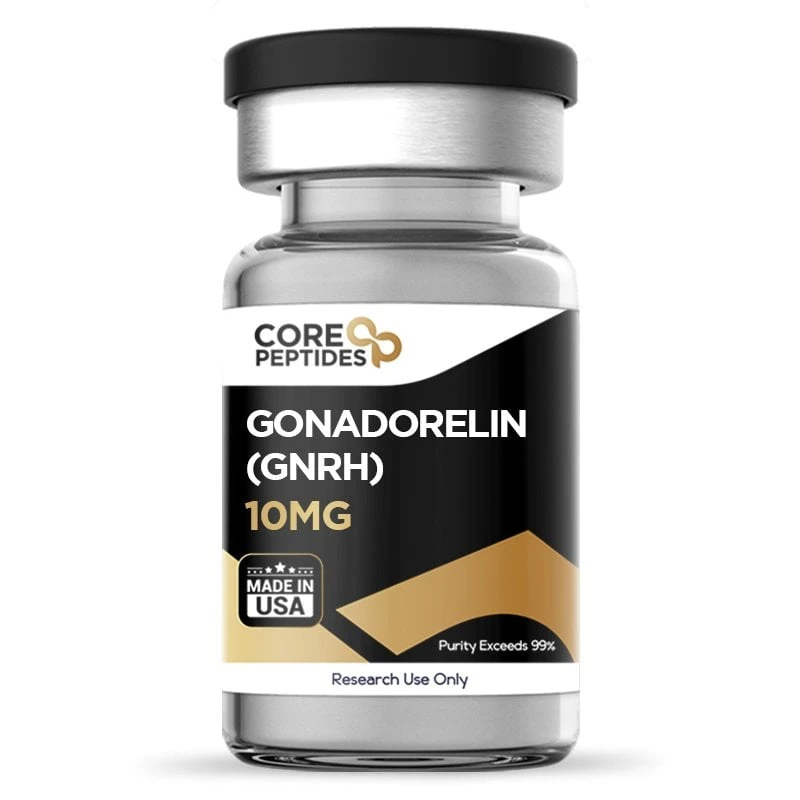
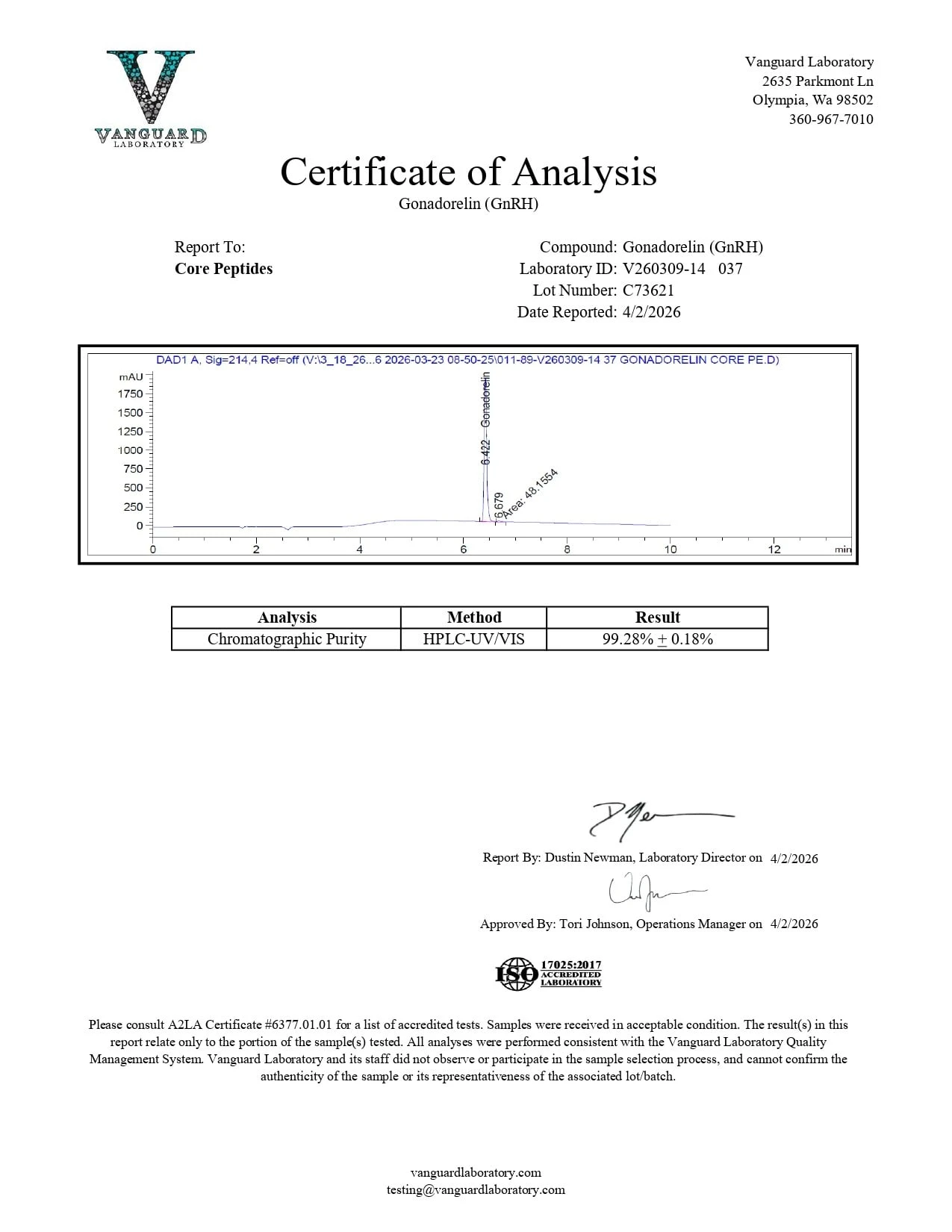
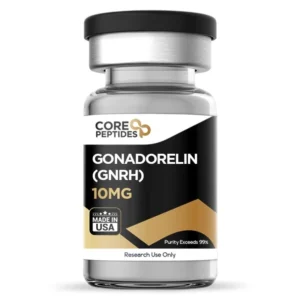
Gonadorelin (GnRH) 10mg
€81.00
Gonadorelin For Sale — Proven GnRH Research Peptide 10mg
Gonadorelin for sale in research-grade form is the synthetic version of gonadotropin hormone-releasing hormone (GnRH) — a ten-amino-acid decapeptide structurally identical to the endogenous hypothalamic GnRH hormone. As the major regulator of gonadotropin secretion, GnRH controls the release of both follicle-stimulating hormone (FSH) and luteinizing hormone (LH) from the anterior pituitary — the gonadotropins that manage and regulate endocrine function and maturation of the gonads. Supplied as a lyophilised powder in a single 10mg vial with a verified purity of >99% for in-vitro scientific research.
⚠️ Research Use Only. This product is intended exclusively for in-vitro scientific research. It is not approved for human or animal consumption, clinical use, or therapeutic application.
Table of Contents
- Product Specifications
- GnRH Biology and Hypothalamic-Pituitary-Gonadal Axis
- Gonadorelin as GnRH Agonist Research Tool
- FSH and LH Regulation Research
- Reproductive Biology Research Applications
- Male Reproductive Research Context
- Research Applications
- Reconstitution and Storage
- FAQ
Product Specifications
| Parameter | Detail |
|---|---|
| Peptide | Gonadorelin (GnRH) |
| Classification | Synthetic GnRH Agonist / Gonadotropin Regulator |
| Amino Acids | 10 |
| Structure | Structurally identical to endogenous GnRH |
| Quantity | 10mg |
| Unit | 1 Vial |
| Form | Lyophilised powder |
| Purity | >99% |
| SKU | P-GONADRLN-10 |
GnRH Biology and Hypothalamic-Pituitary-Gonadal Axis
Gonadorelin occupies a pivotal position in the hypothalamic-pituitary-gonadal (HPG) axis — the endocrine regulatory system governing reproductive function in both male and female biology.
GnRH is produced and released by specialised hypothalamic neurons in a pulsatile pattern — the episodic GnRH pulse frequency and amplitude determining the downstream gonadotropin secretion pattern and ultimately gonadal steroidogenesis. This pulsatile release pattern is critical: continuous GnRH stimulation paradoxically suppresses rather than stimulates gonadotropin secretion through receptor desensitisation — a pharmacological principle of significant relevance to both research protocol design and clinical applications of GnRH analogues.
Gonadorelin’s structural identity with endogenous GnRH makes it the most pharmacologically faithful research tool for investigating native HPG axis biology — enabling researchers to study endogenous GnRH receptor engagement without the modified pharmacology introduced by GnRH agonist or antagonist analogues.
Gonadorelin as GnRH Agonist Research Tool
The gnrh peptide designation of Gonadorelin as a GnRH agonist reflects its capacity to activate GnRH receptors on pituitary gonadotrophs — the pituitary cells that produce FSH and LH — with affinity and activity comparable to endogenous GnRH.
As a GnRH agonist, Gonadorelin engages the GnRH receptor through the same molecular interactions as the native hormone, initiating the intracellular signalling cascade that leads to gonadotropin synthesis and secretion. This pharmacological fidelity to the endogenous hormone makes Gonadorelin a research tool of high mechanistic validity for studies examining GnRH receptor biology, gonadotropin regulation and HPG axis physiology.
FSH and LH Regulation Research
The primary downstream research effects of gonadorelin peptide for sale administration in research models are the regulation of FSH and LH secretion — the two gonadotropins that collectively manage gonadal function.
FSH (Follicle-Stimulating Hormone) — in females, FSH drives follicular development in the ovary and oestrogen production. In males, FSH supports spermatogenesis by stimulating Sertoli cell function and germ cell development.
LH (Luteinizing Hormone) — in females, the LH surge triggers ovulation and initiates corpus luteum formation with progesterone production. In males, LH stimulates Leydig cell testosterone production — the primary gonadal androgen.
Research examining Gonadorelin’s modulation of FSH and LH secretion provides a mechanistic entry point into the full spectrum of gonadal endocrine biology — from oocyte maturation to spermatogenesis, from oestrogen to testosterone regulation.
Reproductive Biology Research Applications
Gonadorelin peptide benefits in reproductive biology research encompass the full HPG axis regulation framework. Research has examined its utility across female reproductive biology — including folliculogenesis, ovulation timing research and luteal phase regulation — as well as male reproductive biology — including spermatogenesis quality, Sertoli cell function and Leydig cell testosterone production.
The compound’s pulsatile administration in research models is particularly important for studies examining physiologically relevant gonadotropin stimulation — given the well-established principle that continuous GnRH exposure leads to receptor downregulation and gonadotropin suppression rather than stimulation.
Male Reproductive Research Context
Gonadorelin for men research contexts typically involve investigation of the HPG axis in male reproductive endocrinology — specifically the GnRH-LH-testosterone axis that governs gonadal androgen production.
Research examining Gonadorelin in male models investigates LH-driven Leydig cell testosterone production, the relationship between GnRH pulse frequency and LH secretion patterns, and the potential of GnRH agonist compounds to stimulate endogenous testosterone production through HPG axis activation. This research direction is distinct from the exogenous testosterone administration context and specifically investigates the stimulation of endogenous gonadal steroidogenesis through the hypothalamic-pituitary pathway.
Research Applications
Gonadorelin is investigated within the following approved in-vitro research domains:
- GnRH receptor binding and gonadotroph activation studies
- FSH and LH secretion regulation research
- Hypothalamic-pituitary-gonadal axis biology
- Female reproductive cycle regulation investigation
- Folliculogenesis and ovulation biology research
- Male reproductive endocrinology — spermatogenesis and testosterone
- Leydig cell and Sertoli cell function research
- GnRH pulsatility and receptor desensitisation studies
- Gonadal endocrine function and maturation biology
Reconstitution and Storage
Reconstitute following standard lyophilised peptide protocols appropriate to your research application. Store lyophilised powder at −20°C. Once reconstituted, maintain at 4°C and use within the timeframe specified by your research protocol. Protect from light and avoid repeated freeze-thaw cycles.
Explore additional reproductive health and endocrine research compounds in our Reproductive Health, Anti-Age and Healing research categories.
FAQ
What is gonadorelin for sale? Gonadorelin for sale is the synthetic version of gonadotropin hormone-releasing hormone (GnRH) — a ten-amino-acid decapeptide structurally identical to endogenous hypothalamic GnRH. It is a GnRH receptor agonist that stimulates FSH and LH secretion from the anterior pituitary, regulating gonadal endocrine function. Research applications span female and male reproductive biology, HPG axis regulation and gonadotropin secretion investigation. Supplied as a 10mg lyophilised powder with >99% purity for in-vitro scientific research.
What is a GnRH peptide and how does gonadorelin relate? A GnRH peptide refers to gonadotropin hormone-releasing hormone or its synthetic analogues. Gonadorelin is specifically the synthetic preparation of native GnRH — structurally identical to the endogenous hormone rather than a modified analogue. As the most pharmacologically faithful GnRH research tool available, it is used for studies requiring authentic GnRH receptor engagement without the modified pharmacology of synthetic GnRH analogues.
What is gonadorelin peptide for sale used for in research? Gonadorelin peptide for sale is used in approved in-vitro research examining GnRH receptor activation, FSH and LH secretion regulation, HPG axis physiology, female reproductive cycle biology (folliculogenesis, ovulation), male reproductive endocrinology (spermatogenesis, testosterone production), GnRH pulsatility and receptor desensitisation studies, and gonadal endocrine function investigation. All applications are within approved in-vitro and preclinical research frameworks.
What is gonadorelin for men research? Gonadorelin for men research typically investigates the GnRH-LH-testosterone axis in male reproductive endocrinology — specifically how GnRH receptor activation drives LH-mediated Leydig cell testosterone production and supports spermatogenesis through FSH-Sertoli cell signalling. Research examines how GnRH pulse frequency and amplitude influence testosterone secretion patterns and the potential for GnRH agonist compounds to stimulate endogenous gonadal steroidogenesis through the natural HPG axis pathway.
What are gonadorelin peptide benefits characterised in research? Gonadorelin peptide benefits characterised in research include GnRH receptor activation with full pharmacological fidelity to endogenous GnRH, FSH and LH secretion regulation enabling downstream gonadal biology research, HPG axis regulation investigation across male and female reproductive contexts, and gonadotropin secretion pattern research. These are in-vitro research characterisations — this compound is not approved for therapeutic reproductive medicine application.
Be the first to review “Gonadorelin (GnRH) 10mg”
Related products
Core Peptides
Weight Loss Research
Reproductive Health Research
Core Peptides
Reproductive Health Research
Core Peptides
Healing and Regeneration research
Immunity Enhancement Research
Reviews
There are no reviews yet.